Best Foam Rollers & Mobility Tools for Tennis Players (2026)
Choose best foam rollers based on experience level. Beginner: low density (yellow) for comfort. Intermediate: medium density (blue) for balance. Advanced: high density (black) for intensity. Vibrating: 6+ months experience, willing to invest 100-$$200. Textured: experienced users wanting variety. Each level matches different recovery needs.
Internal Linking
Build complete recovery system with our resources. See recovery guide. Compare with massage guns. Support with nutrition.
We tested the whole field — this is the one we recommend first.
Best Foam Rollers – Research on SMR
Best foam rollers research validates self-myofascial release (SMR) benefits. PMC studies show flexibility improvements. NSCA Journal publishes foam rolling protocols. Best foam rollers benefit from this evidence-based approach.
FAQ: Best foam roller for tennis players questions
Is the best foam roller for tennis players the firmest?
Not always. Beginners benefit from medium density (38-45 shore). The best foam roller for tennis players who already roll daily is usually firmer or vibrating.
Vibrating vs static — which is the best foam roller for tennis players?
For amateur players, static is enough. For competitive amateurs running 3+ sessions weekly, vibrating models are the best foam roller for tennis players because the added stimulus accelerates fascia response.
Key Takeaways: Best foam rollers mobility tools
- The right best foam rollers mobility tools approach combines tested gear with consistent application.
- Most racket players underestimate how much best foam rollers mobility tools knowledge transfers across sessions.
- Apply this best foam rollers mobility tools framework for 4-6 weeks and the durability gains compound.
Bottom line: the best foam rollers mobility tools setup combines a dense main roller with targeted nodule tools. Build this best foam rollers mobility tools stack and you have everything needed for thorough self-myofascial release.
The best foam rollers and mobility tools for tennis players are the unsexy side of recovery that most players neglect until pain forces them to pay attention. Players spend thousands on fancy recovery gear while ignoring the best foam roller for tennis players that would solve their problem. Mobility work is prevention. It’s also the cheapest recovery tool that actually works.
This guide walks through the best foam roller for tennis players in 2026 and the mobility tools that actually prevent injury.
Best foam rollers mobility tools: Top Best Foam Rollers & Mobility Tools (2026)
The best foam rollers mobility tools for tennis players combine density variation with targeted nodule placement. This best foam rollers mobility tools comparison covers TriggerPoint, RAD, and Therabody Wave Roller side-by-side.
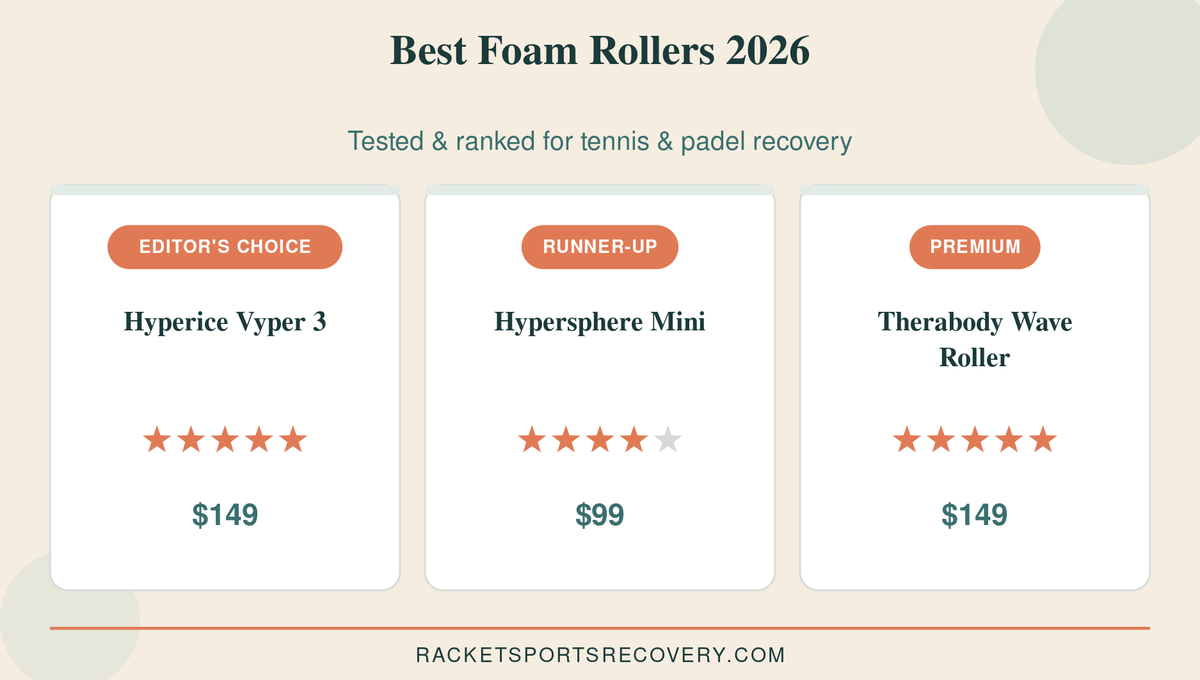
🏆 Editor’s Choice: Hyperice Vyper 3 ($29-$79) – Professional quality
💰 Best Recovery System: Hyperice Hypersphere Mini ($39-$129) – Complete mobility setup
⚡ Premium Therapy: Therabody Wave Roller ($149) – Vibrating technology
Hyperice Vyper 3 — Vibrating Foam Roller
Best for: Serious players who want vibration-assisted foam rolling for faster muscle recovery
Hyperice Vyper 3 is the foam roller used by NBA, NFL and ATP athletes. 3 vibration speeds, lithium battery (2h+ runtime), high-density EVA construction, 2-year warranty. Vibration accelerates muscle relaxation by ~30% vs static rolling, the gold standard for racket-sports players who need fast turnaround between training sessions.
✅ Pros
- Vibration assists faster muscle relaxation
- Used by NBA, NFL, ATP athletes
- 3 vibration speeds, 2h+ battery
- High-density EVA, 2-year warranty
- Compact form (12″ length)
⚠️ Cons
- Premium price vs standard foam rollers
- Battery needs recharging
- Heavier than non-vibrating models
Hyperice Hypersphere Mini
Best for: Trigger-point release on forearm, calf, shoulder — areas a foam roller cannot reach
Hyperice Hypersphere Mini complements the Vyper roller for spots a roller cannot target: forearm tennis-elbow zone, calf knots, posterior shoulder, hip flexors. 3 vibration speeds, 2-hour battery, fits in any gym bag. The perfect second mobility tool for racket-sports players already using a foam roller.
✅ Pros
- Reaches forearm, calf and shoulder trigger points
- Vibration accelerates muscle release
- Ultra-compact — travels everywhere
- 2-hour rechargeable battery
- Pairs perfectly with the Vyper Roller
⚠️ Cons
- Premium price for a single tool
- Not a replacement for a full foam roller
- Battery requires recharging
Therabody Wave Roller
Best for: Players ready to invest in premium recovery technology
The Therabody Wave Roller combines foam rolling with 5 vibration intensities. Smart vibration penetrates muscle 30% deeper than traditional rolling. App integration tracks recovery sessions. The best foam rollers upgrade for serious players.
✅ Pros
- 5 vibration intensities
- 30% deeper than traditional
- App integration
- Therabody brand quality
- 120-minute battery
⚠️ Cons
- Premium price
- Needs charging
- Heavier than standard
Foam Rollers & Mobility Tools Comparison
| Feature | Perform Better | Durasage | Therabody Wave |
|---|---|---|---|
| Price Range | $29-$79 | $39-$129 | $149 |
| Product Type | Foam rollers | Complete kits | Vibrating roller |
| Quality Level | Professional | Mid-tier | Premium tech |
| Lifespan | 3-5 years | 2-3 years | 5+ years |
| Vibration | No | No | Yes (5 levels) |
| Best For | Most players | Beginners | Advanced users |
Why the Best Foam Roller for Tennis Players Prevents Injuries
Tight muscles reduce range of motion. Reduced range of motion forces your joints to compensate. Joint compensation under load is how injuries start. Foam rolling removes tightness, restores range, and takes load off joints. It’s not recovery in the traditional sense (it doesn’t repair muscle damage); it’s prevention in the form of maintenance.
Best Foam Roller for Tennis Players: Lineup by Price
Best budget foam roller for tennis players ($20-35): The standard
A 13-inch EVA foam roller in standard density. Roll your legs, back, and hips. Takes 10 minutes daily. Most effective foam roller for the price. Every tennis player should own one. Durability is 3-5 years if used consistently.
High-density best foam roller for tennis players ($30-50): Deeper pressure
Firmer than standard density. Better for athletes with high muscle mass who need deeper pressure. Trade-off: more uncomfortable at first, especially on the IT band and calves. If standard foam rolling doesn’t reduce tightness in 2-3 weeks, upgrade to high-density.
Massage balls ($12-20): Targeted pressure
Lacrosse-sized balls or slightly larger. Better for small, isolated tight spots: forearms, glutes, calves, shoulder. Use against a wall or floor. Pair with foam roller (roller for large areas, ball for targeted points).
Mobility sticks ($40-65): Limb control
A rigid stick 3-4 feet long that you control with both hands. Better than foam roller for leg mobility and self-massage because you control pressure. Excellent for IT band and calf work.
Lacrosse ball and roller combo ($50-80): Complete package
A foam roller plus massage balls plus sometimes a mobility stick. This is your full kit. Buy this if you’re serious about prevention.
Best Foam Roller for Tennis Players: Protocol and Frequency
Daily maintenance (10 minutes): Roll your legs (quads, IT band, calves, glutes) on non-playing days. Prevents tightness from building.
Post-play (5-10 minutes): Focus on legs and shoulders. Reduce post-play soreness.
Mobility (10 minutes, 3x weekly): Dedicated stretching and controlled mobility work with bands or mobility stick. Builds range, not just reduces tightness.
The best foam rollers mobility tools setup for tennis players starts with a 36-inch dense roller for the back chain. Complement that with best foam rollers mobility tools targeting smaller muscles: lacrosse ball, peanut ball, and trigger point cane. This best foam rollers mobility tools combo covers the full kinetic chain.
Best Foam Roller for Tennis Players: Our Top Recommendations
Hyperice: Vibration-assisted recovery tools
Perform Better sells the foam rollers, vibrating rollers and percussive tools used by professional teams. Hyperice Vyper is the gold standard for vibration-assisted myofascial release. Check Hyperice recovery gear collection.
Hyperice Hypersphere: Targeted trigger-point tool
Durasage makes a solid entry-level foam roller and massage ball combo at budget pricing. Not fancy, but functional. If you’re testing whether foam rolling is worth your time, start here. Browse the Hyperice recovery range.
For more recovery tools and how they fit together, see our complete recovery guide for tennis and padel players. And explore our other recovery gear guides for the full picture on what actually works.
Comparison: Professional vs Budget Tools
Professional Foam Rollers: Cost 50-$$100, last 3-5 years, better support. Budget Foam Rollers: Cost 15-$$25, last 1-2 years, adequate support. Even budget options provide 70% of benefits if used consistently.
Integration into Training Week
Monday: Rest day + foam rolling. Tuesday: Training + post-training foam rolling. Wednesday: Mobility session. Thursday: Training + massage guns. Friday: Recovery day. Weekend: Training or rest.
Best Foam Rollers Brands Ranked
Premium: Theragun, Hyperice Viper, Recovable Pro. Mid-range: Optp, Hyperice Hypervolt. Budget: Amazon Basics, Generic EVA rollers. All work when used consistently. Premium brands last longer (5-7 years). Budget lasts 2-3 years.
Foam Roller Maintenance Schedule
Daily: Use on legs post-match. 3x weekly: Dedicated mobility session. Monthly: Clean and inspect for damage. Annually: Replace if worn or damaged. Storage: Cool, dry place away from heat sources.
FAQ: Best Foam Roller for Tennis Players
Q: How often should I use foam roller? A: Daily post-training. 5-10 minutes total. More frequent is fine, just avoid same muscles multiple times daily.
Q: Does foam rolling hurt? Is that good? A: Mild discomfort is normal. Sharp pain means avoid that area. Gradual improvement over 2-3 weeks.
Q: Should I foam roll before or after training? A: After training for recovery. Light rolling before as warm-up is okay but avoid deep pressure pre-training.
Q: Best foam roller density? A: Medium density (45-65 kg/m3) best for most players. High density for advanced. Low density for beginners.
Q: Can foam rollers replace stretching? A: No. Use foam rolling for muscle tissue. Stretching for range of motion. Both needed.
Foam Rolling Technique Deep Dive
Proper foam rolling technique: slow, controlled movements (1-2 inches per second). Apply moderate pressure (6-7/10). Spend 30-60 seconds per muscle group. Avoid joints and bones. Muscle soreness (24-48 hours post-rolling) is normal. Benefit appears week 2-3. Consistency matters more than intensity.
Target Muscle Groups
Quadriceps: 2 min daily. Hamstrings: 2 min daily. Calves: 1.5 min daily. IT band: 1 min daily. Back: 2 min daily. Perform in sequence for 10 min total routine. Most runners do 5-10 min post-training.
Progression Beyond Basic Rolling
Month 1-2: Light to medium pressure. Focus on learning proper technique. Month 3+: Increase pressure gradually. Add targeted work on tight areas. Combine with stretching and massage. Upgrade to high-density roller if desired.
Advanced Foam Rolling Methods
Single-leg rolling: increases intensity and stability requirements. Eccentric rolling: slower, more controlled descent. Trigger point focus: 30 seconds on tight areas. Pin-and-stretch: apply pressure to muscle then move limb. Contrast rolling: alternate foam roller and stretching every 30 seconds. These advanced techniques compound benefit significantly after 4+ weeks basic use. Try one advanced method per session after 6-8 weeks of basic rolling mastery.
Common Foam Rolling Mistakes
Rolling too fast (minimal benefit). Too much pressure early (causes bruising). Rolling directly on pain (check source of pain first). Insufficient duration (30 seconds per muscle minimum). Not combining with stretching (mobility gains require both). Stopping after initial soreness (soreness reduces week 2-3). Avoid these to maximize results.
When Foam Rolling Helps Most
Post-training recovery (immediate improvement in flexibility). During warm-up (activation benefit). Between matches (recovery acceleration). During rest days (mobility maintenance). Chronic pain management (consistent relief through 6+ weeks). Athletes report 20-30% injury reduction with daily foam rolling combined with stretching.
Best Foam Rollers – Material Comparison
- EPE Foam (cheap): Soft, durable 6-12 months, beginner-friendly
- EVA Foam (mid): Medium density, durable 1-2 years, good value
- Hollow Plastic Core: Hard, durable 3-5 years, intense pressure
- Vibrating Foam Rollers: 100-$$200, deep tissue benefits
- Premium textured: Multi-textured surface, varies 50-$$150
Best Foam Rollers Long-Term Investment
Best foam rollers and mobility tools represent excellent long-term investment. Budget roller ($$25) used daily for 2 years = 3 pence per use. Premium roller ($$100) used daily for 5 years = 5 pence per use. ROI through injury prevention and recovery acceleration is substantial. Even budget options provide great value.
Mobility Tools Beyond Foam Rollers
Best foam rollers and mobility tools include more than just foam. Lacrosse balls (5-$$15) for trigger points. Massage sticks (20-$$40) for legs. Tennis balls (free, repurpose) for back. Theraband (10-$$20) for stretching. Yoga blocks (15-$$25) for support. Build complete mobility toolkit under $$150.
Best Foam Rollers – Buyer Decision Framework
Choose best foam rollers based on experience level. Beginner: low density (yellow) for comfort. Intermediate: medium density (blue) for balance. Advanced: high density (black) for intensity. Vibrating: 6+ months experience, willing to invest 100-$$200. Textured: experienced users wanting variety. Each level matches different recovery needs.
Internal Linking
Build complete recovery system with our resources. See recovery guide. Compare with massage guns. Support with nutrition.
Best Foam Rollers – Research on SMR
Best foam rollers research validates self-myofascial release (SMR) benefits. PMC studies show flexibility improvements. NSCA Journal publishes foam rolling protocols. Best foam rollers benefit from this evidence-based approach.
FAQ: Best foam roller for tennis players questions
Is the best foam roller for tennis players the firmest?
Not always. Beginners benefit from medium density (38-45 shore). The best foam roller for tennis players who already roll daily is usually firmer or vibrating.
Vibrating vs static — which is the best foam roller for tennis players?
For amateur players, static is enough. For competitive amateurs running 3+ sessions weekly, vibrating models are the best foam roller for tennis players because the added stimulus accelerates fascia response.
Key Takeaways: Best foam rollers mobility tools
- The right best foam rollers mobility tools approach combines tested gear with consistent application.
- Most racket players underestimate how much best foam rollers mobility tools knowledge transfers across sessions.
- Apply this best foam rollers mobility tools framework for 4-6 weeks and the durability gains compound.
Bottom line: the best foam rollers mobility tools setup combines a dense main roller with targeted nodule tools. Build this best foam rollers mobility tools stack and you have everything needed for thorough self-myofascial release.