Padel Wrist Pain Recovery: 4-Week Protocol That Works (2026)
Disclosure: This guide contains affiliate links. If you buy through them, we earn a commission at no cost to you. See our affiliate disclosure.
Padel wrist pain recovery is the conversation no one has at the club until a player suddenly cannot grip a racket anymore. After the knees, the wrist is the most-injured joint in padel — clinic data from Padel Tonic and Isokinetic Magazine puts it at roughly 20–25 % of all padel-related physiotherapy consultations. The brutal news for amateur players: padel wrist pain almost never resolves on its own without addressing the technique, the grip, and the recovery protocol together. This guide walks through why padel destroys wrists, the four most common injuries, and the exact 4-week recovery plan that actually works.
See our tested-and-ranked picks in Best Massage Guns for Tennis & Padel Players (2026).
Why Padel Hurts Wrists More Than Tennis
Tennis players think padel looks easy until they play 90 minutes and wake up with a wrist that will not turn a doorknob. The mechanics that drive padel wrist pain are very different from tennis:
- The continental grip is non-negotiable. Unlike tennis where you switch between forehand and backhand grips, padel keeps you on a continental grip across every shot. Your wrist absorbs the rotational load that a tennis backhand grip would otherwise share.
- The padel racket has no strings. A perforated foam-and-carbon racket transmits more impact to the wrist than a strung tennis racket, especially on off-centre hits.
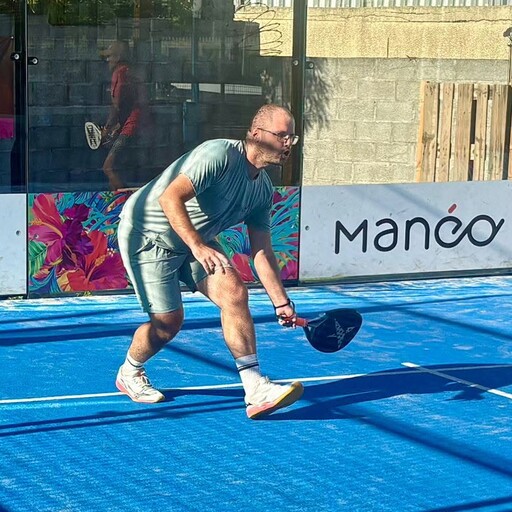
- Glass-wall recovery shots. When you chase a ball that has bounced off the back glass, the recovery shot is often hit at a wrist-strained angle — from below the hip, with the wrist as the only joint that can adjust the racket face.
- Slice and chiquita shots. The signature padel shots load the ulnar side of the wrist (the side toward the little finger) in ways tennis simply does not. That is where the TFCC sits.
The Four Wrist Injuries Padel Players Get
1. TFCC injury (triangular fibrocartilage complex tear)
The TFCC is the cartilage cushion on the pinky side of the wrist. Padel players develop TFCC pain after months of glass-wall recovery shots. The pain shows up on the ulnar side when you turn a doorknob or open a jar. This is the most common — and most often misdiagnosed — padel wrist pain recovery case.
2. Wrist extensor tendinopathy
Pain on the top of the wrist (the back of the hand side), aggravated by lifting the wrist against resistance. Often co-exists with tennis-elbow-like forearm pain. Common in players who grip too tight.
3. De Quervain's tenosynovitis
Pain on the thumb side of the wrist. Aggravated by gripping or twisting the racket on slice shots. Often confused with simple wrist sprain — but De Quervain's requires a specific tendon-glide protocol that generic wrist rest will not fix.
4. Wrist sprain (ligament strain)
Sudden onset, often after a single mistimed shot off the back glass. Swelling, bruising, sharp pain on movement. Different recovery arc from the chronic injuries above — needs acute management first.
Self-Diagnosis: When You Can Self-Treat, When You Must See a Doctor
Try this padel wrist pain recovery self-check before committing to a protocol:
- Self-treatable signs: dull ache that builds over a session, stiffness in the morning that eases with movement, pain only when gripping hard or slicing, full passive range of motion (someone else can move your wrist normally).
- See a sports doctor immediately: visible swelling that lasts more than 48 hours, pinky-side wrist click or catching sensation, numbness or tingling in the hand, inability to bear any weight on the wrist, sharp pain at rest, pain after a clear traumatic event (fall, smash off the head).
The 4-Week Padel Wrist Pain Recovery Protocol
Week 1 — Calm the tissue
Stop padel for 7 days. This is the only mandatory rule of padel wrist pain recovery. Ice 10–15 minutes after any activity that aggravates. Use a compression wrap during the day for support. NSAIDs if your doctor approves — short course only. Begin gentle wrist circles, 10 each direction, twice daily, pain-free range only.
Week 2 — Restore mobility
Wrist flexor and extensor stretches, 30 seconds each, 3 sets, 2x per day. Begin isometric wrist holds (push wrist against a fixed surface in all 4 directions, 5 seconds each, no movement). Continue ice or contrast bath as needed. Start using a Therabody massage gun on the forearm (NOT directly on the wrist joint) for 2–3 minutes per session to release the muscles that pull on the wrist.
Week 3 — Strengthen progressively
Begin eccentric wrist extensions and flexions with a light dumbbell (0.5–1 kg). Slow lowering, 3 sets of 15 reps, daily. Add grip-strength work with a soft squeeze ball, 30 reps per hand, 2x per day. Begin red light therapy sessions if the pain is tendon-based — 10 minutes per session, 3–5 times per week. The NovaaLab Light Pad wraps directly around the wrist for the right dosage.
Week 4 — Return to padel progressively
Start with 30 minutes of light hitting on Week 4 Day 1. Increase by 15 minutes every other session if pain stays below 3/10. Wear a wrist compression sleeve during play (Hyperice or any sports-grade compression). Continue the strengthening work post-session. By the end of Week 4, you should be back to 80–90 % of normal session length with negligible pain.
The Gear That Helps Padel Wrist Pain Recovery
🛠️ Recommended Padel Wrist Pain Recovery Gear
Hyperice Normatec Arm
Pneumatic compression for the entire forearm and wrist — circulation boost post-session
$649
View Hyperice →NovaaLab Light Pad
Red light therapy wearable that wraps around the wrist for TFCC and tendon healing
$199–$449
View NovaaLab →Therabody Theragun Mini
Compact massage gun for forearm release (never directly on the wrist joint)
$199
View Therabody →Disclosure: We earn a commission if you purchase through our links at no cost to you.
Long-Term Padel Wrist Pain Prevention
Recovering once is fine. The harder part of padel wrist pain recovery is making sure it does not come back. Five rules that work:
- Loosen your grip. Most amateur padel players grip the racket 30–40 % tighter than necessary. A loose, relaxed grip lets the forearm muscles do the work instead of the wrist. Practice during warm-up: hold the racket so loosely that it would fall if someone tapped it.
- Check your racket weight. A racket above 380 g (especially head-heavy) loads the wrist on every shot. If you are recovering from wrist pain and your racket is over 380 g, consider switching to a 365–375 g model during the recovery phase.
- Build forearm endurance. Two 10-minute forearm sessions per week (wrist curls, reverse curls, farmer carries) builds the supporting muscles that prevent wrist overload.
- Warm up the wrist specifically. 30 seconds of wrist circles plus 10 air slices before stepping on court. Cold wrists are injured wrists.
- Wear a sleeve for chronic cases. If you have had two or more wrist pain episodes, wear a compression sleeve during play permanently. The compression provides proprioceptive feedback that reduces over-extension.
FAQ: Padel Wrist Pain Recovery
How long does padel wrist pain take to heal?
Minor strains: 2–3 weeks. Tendon injuries: 4–8 weeks. TFCC tears: 6–12 weeks for conservative management; longer if surgery is required. The 4-week protocol above is the realistic target for the majority of overuse cases.
Can I play padel with wrist pain?
Not during weeks 1–2 of an acute flare. Playing through tendinopathy makes it chronic. Return progressively in week 4 with reduced session length and a compression sleeve.
Is a wrist brace better than tape for padel?
For acute injuries: brace (immobilises). For chronic tendinopathy and progressive return: compression sleeve (supports without restricting). Avoid heavy bracing during play once you are past the acute phase — it weakens supporting muscles long-term.
Does padel grip size matter for wrist injuries?
Less than in tennis, because padel grips are smaller and more standardised. But grip thickness matters — if you wrap an extra overgrip on top of your grip, you change the geometry and can aggravate the wrist over time. Stick to one overgrip during recovery.
Should I see a doctor for padel wrist pain?
Yes if pain persists past 2 weeks of correct protocol, if there is visible swelling, if you have numbness or tingling, or if there was a clear traumatic event. The padel wrist pain recovery cases that turn chronic are almost always the ones the player tried to manage solo for 6+ months before seeing a professional.
Padel Wrist Pain Recovery in the Full Recovery System
Wrist pain rarely travels alone — it usually arrives with forearm tightness or elbow inflammation. Read our tennis elbow recovery guide for the related forearm protocol. For the tools that support wrist and arm recovery, see our massage gun comparison and our compression gear reviews. The complete recovery guide for tennis and padel players ties it all together.
Evidence sources: The 4-injury classification and rehab timelines align with published Mayo Clinic wrist pain guidance and TFCC tear management research indexed on PubMed.
The Bottom Line on Padel Wrist Pain Recovery
Padel wrist pain recovery comes down to four habits: catch the injury early, run the 4-week loading protocol with discipline, audit the grip technique that started the problem, and stack the right gear (red light, compression, percussion) alongside the work. Players who follow the full padel wrist pain recovery system come back to court at full strength — and stay there. The wrist is not a season-ender if you treat it like the priority it is.
Padel wrist pain recovery is a 4-week protocol, not a 4-day rest. Calm the tissue in week 1, restore mobility in week 2, strengthen in week 3, return to play in week 4. The most under-recognised injury is the TFCC tear from glass-wall recovery shots — if your pain is on the pinky side and clicks, see a sports doctor before any home protocol. For everything else, the combination of forearm massage gun release, red light therapy on the wrist tendons, and progressive strengthening recovers 80 % of cases without specialist intervention. The five long-term rules — loose grip, racket weight check, forearm endurance, specific warm-up, compression sleeve for chronic cases — are what keep it from coming back.