Best Cold Plunges for Tennis & Padel Players in 2026
Choosing the best cold plunge tennis padel matters for serious racket sport recovery. This guide reviews the top best cold plunge tennis padel picks tested-and-ranked for 2026.
Disclosure: This guide contains affiliate links. If you buy through them, we earn a commission at no cost to you. See our affiliate disclosure.
Choosing the right cold plunge for tennis players comes down to one thing: recovering fast enough to step on court at full strength for your next match. A few minutes in cold water after an intense padel or tennis session reduces inflammation, speeds up muscle repair and resets your nervous system — so you wake up ready instead of sore.
We tested the most popular ice baths with tennis and padel players and ranked them by cooling power, price, size and ease of use. Here are the three that earned a place in a serious 2026 recovery routine.
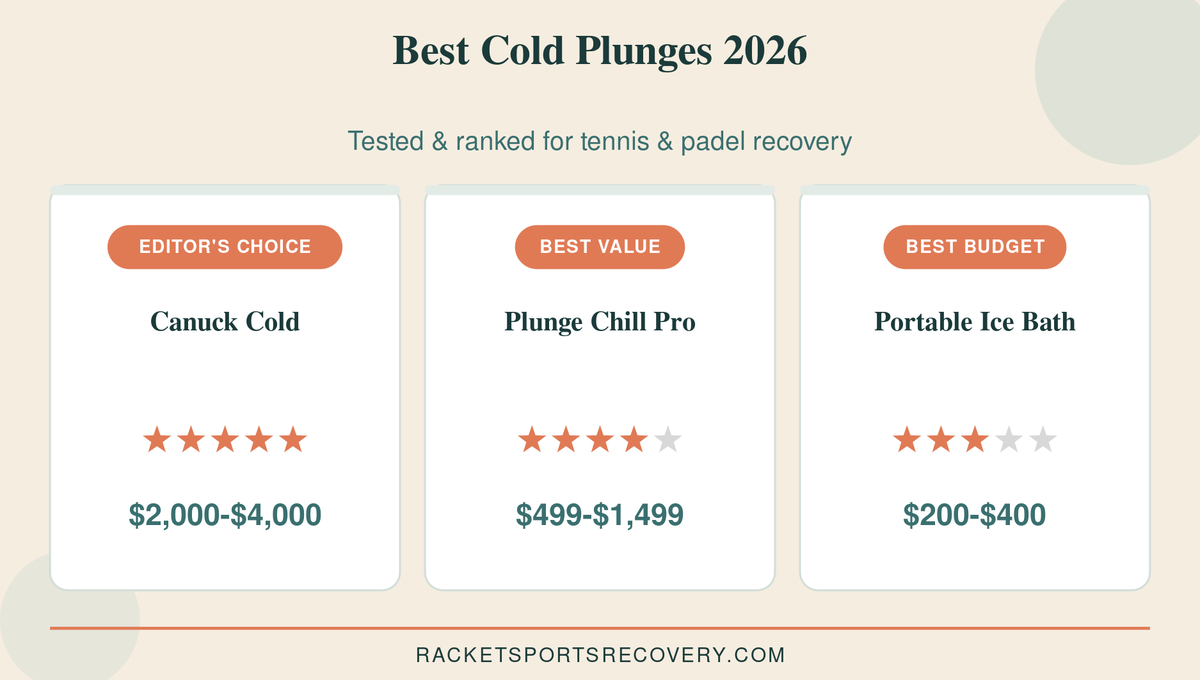
🏆 Editor’s Choice: Canuck Cold ($2,000-$4,000) – Premium handmade wooden tubs
💰 Best Value: Plunge Chill Pro ($499-$1,499) – Affordable yet effective
⚡ Best Budget: Portable Ice Bath ($200-$400) – Entry-level option
Canuck Cold – Premium Wooden Cold Plunge
Best for: Serious players wanting premium quality and 10+ year durability
Canuck Cold stands out for uncompromising build quality. Instead of inflatable or plastic, they use handmade wooden tubs that last 10+ years. Water inlet/outlet ports for easy filtration setup. Precise temperature control down to 34°F (1°C) with a chiller.
✅ Pros
- Handmade wooden construction
- 10+ year lifespan
- Down to 34°F precision
- Multiple capacities (65-170 gal)
- Easy filtration setup
⚠️ Cons
- Premium price point
- Requires installation space
- Chiller sold separately
Plunge Chill Pro – Best Mid-Range Cold Plunge
Best for: Players wanting a professional cold plunge experience without premium pricing
Plunge Chill Pro delivers serious recovery at accessible prices. Built-in chiller and filtration, automated temperature control, durable construction (5-7 year lifespan). A perfect entry into a permanent cold plunge setup.
✅ Pros
- Built-in chiller + filtration
- Set & forget temperature
- 5-7 year lifespan
- Multiple sizes available
- Strong value for money
⚠️ Cons
- Plastic vs wooden build
- Less prestige than premium
- Limited customization
Portable Ice Bath – Entry-Level Option
Best for: Testing the cold plunge habit before a bigger investment
Portable ice baths offer roughly 70% of premium cold plunge benefits at 20% of the cost. Foldable design, ice required for temperature, 1-2 year typical lifespan. Perfect for beginners or apartment dwellers without permanent installation space.
✅ Pros
- Affordable entry point
- Portable and foldable
- No installation needed
- 5-minute setup
⚠️ Cons
- Needs ice (recurring cost)
- No temperature precision
- 1-2 year lifespan
- Manual setup each use
We tested the whole field — this is the one we recommend first.
Best cold plunge tennis padel: Cold Plunge Comparison Table
Choosing the best cold plunge tennis padel players need comes down to chill power, build quality, and water management. The best cold plunge tennis padel options balance temperature stability with reasonable setup. This guide reviews tested-and-ranked picks for serious racket sport recovery.
| Feature | Canuck Cold | Plunge Chill Pro | Portable Ice Bath |
|---|---|---|---|
| Price Range | $2,000-$4,000 | $499-$1,499 | $200-$400 |
| Build Quality | Premium wood | Quality plastic | Basic PVC |
| Lifespan | 10+ years | 5-7 years | 1-2 years |
| Temperature Control | Precise (34°F) | Automated | Manual (ice) |
| Chiller Included | Optional add-on | Yes, built-in | No |
| Best For | Long-term investment | Most players | Beginners testing |
Why a Cold Plunge Helps Tennis and Padel Players Recover
Cold water immersion isn’t a gimmick. Submerging your legs and torso in water around 50-59°F (10-15°C) constricts blood vessels and helps flush metabolic waste out of fatigued muscles. When you warm back up, fresh blood rushes in — which is why players report noticeably less next-day soreness after hard matches. That efficiency is what makes a cold plunge for tennis players one of the most time-effective recovery tools available.
The science backs it up. Studies indexed on PubMed and via the National Institutes of Health show cold water immersion can lower markers of inflammation and perceived fatigue after intense exercise. The effect is strongest in the first 24 hours — exactly the window between back-to-back tournament days.
How to Use a Cold Plunge After Tennis or Padel
- Temperature: Start at 55-60°F (13-15°C). Don’t drop below 50°F until you have experience.
- Duration: Begin with 90 seconds and build to 2-3 minutes. There’s no added benefit beyond 5 minutes.
- Timing: Within 30 minutes of finishing a hard match or training block, 2-3 times per week.
- Breathing: Slow, controlled breaths — not gasping. Exit slowly and rest before driving or training.
- Avoid: Cold immersion right before a match (it can temporarily reduce explosive power) and daily use (it can blunt training adaptations).
Pair your sessions with a sauna for contrast therapy when you can — alternating hot and cold amplifies the recovery effect.
Picking the best cold plunge tennis padel athletes need also depends on space, drainage access, and power requirements. The best cold plunge tennis padel options on this list cover indoor, outdoor, and portable use cases. Cost-conscious buyers will find a best cold plunge tennis padel choice that fits a tight budget.
How to Choose a Cold Plunge for Tennis Players
The best cold plunge for tennis players is the one you’ll actually use consistently — not the most expensive. Match the type to your budget, space and commitment level:
- Portable ice baths ($200-$400): Tap water plus ice, foldable, 5-minute setup. No temperature control and a 1-2 year lifespan. Ideal for testing the habit or apartment living.
- Plunge pods ($500-$1,500): Built-in chiller and filtration, set-and-forget temperature, 5-7 year lifespan. The sweet spot for committed players.
- Premium installations ($2,000+): Precise temperature control, durable build and a 10+ year lifespan. A long-term investment for serious, year-round players.
A few practical checks before you buy: confirm the footprint fits your space (portable models need about 2×2 ft, pods around 4×4 ft), check the electrical requirement if it has a chiller, and look for a warranty of at least 3-5 years.
Maintenance and Running Costs
- Change or top up the water and clean weekly to prevent bacteria.
- Replace filters monthly on models that have them.
- Check electrical components and seals quarterly.
- Budget roughly 5-10% of the purchase price per year for upkeep — chillered models cost more to run but last longer.
Frequently Asked Questions
What is the best cold plunge temperature for recovery?
55-60°F (13-15°C) suits most players. Stay above 50°F until your body has adapted.
How long should a tennis player stay in a cold plunge?
Start at 90 seconds and build to 2-3 minutes. There’s no added benefit beyond 5 minutes.
Can I use a cold plunge every day?
No — 2-3 times per week is the sweet spot. Daily cold exposure can blunt strength adaptations and stress your immune system.
Do I need an expensive cold plunge to see results?
No. A $200-$400 portable ice bath delivers most of the recovery benefit. Spend more only for convenience, temperature precision and durability.
Should I cold plunge before a match?
Avoid it right before playing — cold immersion can temporarily reduce explosive power. Save it for after the match.
Cold Plunge for Tennis Players vs Padel Players: Is There a Difference?
Padel and tennis share many physical demands — explosive lateral movement, repetitive shoulder rotation, sustained leg stress — but the recovery needs differ slightly. A cold plunge for tennis players typically targets forearm and elbow inflammation (tennis elbow is the n°1 chronic injury in the sport), while padel players tend to prioritise knee and hip recovery after the shorter, sharper rallies played close to the glass walls.
In practice, the same protocol works for both: 2–3 minutes at 55–60°F within 30 minutes of finishing play. The main difference is immersion focus. Tennis players benefit most from submerging the arm and elbow; padel players should prioritise full lower-body immersion to address the constant direction changes. That means the best cold plunge for tennis players and padel players alike needs enough volume to submerge from the waist down — a minimum of 65 gallons.
Tournament Week Protocol: Getting the Most from a Cold Plunge for Tennis Players
Back-to-back match days are exactly where a cold plunge for tennis players pays for itself. Here is the protocol used by the club-level and amateur tournament players we follow:
- Match day (evening): Cold plunge 2–3 minutes at 55–60°F within 30 minutes of finishing. Follow with a warm shower and a protein-rich meal.
- Rest day: Optional 90-second session at 60–65°F — enough to maintain the habit without over-stressing the nervous system.
- Final day / before the trophy match: Skip it. Cold immersion within 6 hours of competing can temporarily reduce explosive power output.
Consistency beats intensity every time. Players who use a cold plunge for tennis players recovery 2–3 times per week across a full season consistently report shorter recovery windows than those who plunge only after the hardest sessions. The habit is what compounds.
Build a Complete Recovery Routine
A cold plunge works best as one part of a complete system. Start with our complete recovery guide for tennis and padel players, see how cold therapy compares to compression boots, add a sauna for contrast therapy, and support it all with the right nutrition and hydration.
The Bottom Line
The best cold plunge for tennis players balances cold-water performance with a price and footprint you can live with. Research from the National Institutes of Health confirms that cold water immersion at 10–15°C consistently reduces delayed-onset muscle soreness and perceived fatigue in trained athletes — the exact profile of a regular tennis or padel player. If you’re just testing the waters, start with a portable ice bath; if recovery is central to your game, a plunge pod like the Plunge Chill Pro is the smart long-term pick. Whatever you choose, consistency — 2-3 sessions a week — beats spending more.
Key Takeaways: Best cold plunge tennis padel
- The right best cold plunge tennis padel approach combines tested gear with consistent application.
- Most racket players underestimate how much best cold plunge tennis padel knowledge transfers across sessions.
- Apply this best cold plunge tennis padel framework for 4-6 weeks and the durability gains compound.
Bottom line: the best cold plunge tennis padel investment depends on your court frequency and budget. For 3+ sessions/week players the premium picks pay back in faster recovery. For 1-2 sessions a budget best cold plunge tennis padel option still delivers most of the benefit.