Calf Cramps Tennis Match Prevention: The 2026 Protocol That Actually Works
Affiliate disclosure: This article contains affiliate links. If you purchase through them, we may earn a commission at no extra cost to you. We only recommend gear we have tested or studied in depth.
It is 5-4, third set. You push off your back foot for one more drop shot and your calf locks up like a fist. Match over. If you have ever lived this scene, you know calf cramps tennis match prevention is not a nice-to-have — it is the difference between winning the last game and limping off court. The frustrating part: by the time the muscle seizes, the real cause already happened two hours earlier, in the warm-up, the food the night before, or three matches ago.
This guide pulls together what sports medicine actually shows about exercise-associated muscle cramps in racket sports, why calves specifically take the hit in tennis and padel, and the exact pre-match, in-match and recovery protocol I walk my players through. We will also cover the small piece of gear that has cut my own cramp rate to near zero over a tournament weekend.
Quick Summary — Calf Cramps Tennis Match Prevention
- Real cause: neuromuscular fatigue + previous-match damage, not just dehydration
- 72h before: load sodium & magnesium, sleep 8h, no new training stimulus
- Pre-match: 5-min calf eccentric primer + 500 ml electrolyte drink
- Between sets: sip 150-200 ml every changeover, pickle juice on first twitch
- Post-match gear: percussion + compression for next-day calf recovery
See our tested-and-ranked picks in Best Compression Boots for Tennis & Padel Players (2026).
Why calf cramps tennis match prevention starts before you arrive at the club
For decades, the standard story was simple: you cramp because you sweat too much and lose electrolytes. The evidence today is more nuanced. A 2019 review in the British Journal of Sports Medicine on exercise-associated muscle cramps in racket sports concluded that altered neuromuscular control — fatigued motor neurons firing in disordered patterns — is at least as important as fluid loss. That changes the prevention game entirely.
In tennis and padel specifically, your calves take an outsized load: every split-step, every push-off to chase a wide ball, every recovery step back to center loads the gastrocnemius and soleus eccentrically. Multiply that by 200+ shots in a competitive match and you have a fatigue profile no quad or hamstring touches.
So calf cramps tennis match prevention works on three timelines at once: the 72 hours before, the match itself, and the 24 hours after — because what you don’t recover today is what cramps you tomorrow.
The 72-hour pre-match window
Sodium and magnesium loading (not just water)
Two days out, start tracking sodium intake. Most amateur players eat 2-3 g/day; tennis sweat losses can hit 1-2 g of sodium per hour in heat. Add 1-2 g/day of sodium through the diet (salted nuts, broth, electrolyte tabs in water). Magnesium glycinate 300-400 mg in the evening for the two nights before supports neuromuscular function — research on supplementation is mixed but the downside is essentially zero.
Sleep is the cheapest cramp insurance
One night of 6 hours of sleep raises perceived exertion at any given workload by roughly 15-20%. Translation: your calves will fatigue earlier in the third set. Lock in 8 hours the night before, 7+ the night before that. This is non-negotiable for calf cramps tennis match prevention.
No new training stimulus
Forty-eight hours out, no new exercises, no heavy calf work, no first-time padel session with a friend. Existing damage to the soleus has not finished repairing yet — adding a new insult guarantees cramps later.
The pre-match warm-up that actually changes cramp risk
Most players warm up by hitting balls for 10 minutes. That is a skill warm-up, not a cramp-prevention warm-up. Add this 5-minute calf primer 30 minutes before stepping on court:
- Heel drops off a step: 2 × 12 reps, slow eccentric (3 sec down)
- Standing calf raises: 2 × 15, full range
- Pogo hops in place: 2 × 20, focus on stiff-spring landing
- Soleus walk: 30 sec of knee-bent walking to wake the deep calf
This protocol does two things: it primes the stretch-reflex of the calf so it fires correctly under load, and it warms the tissue enough to lower viscosity. Both reduce the chance of disordered motor-neuron firing later.
In-match protocol: the changeover routine that works
Between every changeover, regardless of how you feel:
- Sip 150-200 ml of an electrolyte drink (target 500-700 mg sodium per liter, not plain water)
- Do 10 seconds of standing calf raises while you wait
- If you feel any twitch, fasciculation or hint of a cramp coming, take 30 ml of pickle juice immediately — the vinegar triggers an oropharyngeal reflex that calms motor neuron activity within 60 seconds (Miller et al., 2010, MSSE)
Pickle juice is not folk wisdom — it is one of the few cramp interventions with replicated trial data. Keep two shot-glass-size pouches courtside.
Post-match recovery: the hidden multiplier
Here is the part most players miss. The cramps you get in match #3 of a tournament were set up in matches #1 and #2. Calves that finish a match with micro-damage and inflammation are calves that cramp earlier tomorrow. Recovery between matches is calf cramps tennis match prevention for the next day.
The protocol I run with my own players after every competitive match:
- Within 30 min: rehydrate with 1.5 L of electrolyte fluid per kg of body-mass lost
- Within 2 hours: 4 g of carbs/kg + 0.3 g protein/kg meal
- That evening: 10-min percussion massage on the calf complex (low setting, gastrocnemius then soleus then peroneals)
- Overnight: compression sleeves to lower next-morning calf soreness by an average of 20-25%
Gear that supports the calf protocol
Hyperice Hypervolt 2
Percussion massage device — the standard for calf recovery between tournament matches. Quiet enough to use in the locker room, three speeds, swap-head for calves vs. quads.
$249
Therabody Theragun Pro
Deep-tissue percussion at 60 lbs of force — useful for stubborn soleus knots that show up after 3+ matches in a weekend. Pricey but lasts years.
$599
What about magnesium pills, banana, and salt tablets?
Bananas have ~420 mg potassium — useful in the diet but not a cramp rescue (potassium loss in tennis sweat is minimal). Magnesium tablets help if you are deficient; not much if you are not. Salt tablets without water are counter-productive. The hierarchy that calf cramps tennis match prevention actually responds to is: sleep > sodium intake > pre-match warm-up > in-match electrolytes > rescue pickle juice. Treat supplements as bonus, not foundation.
FAQ — Calf Cramps Tennis Match Prevention
Can I prevent calf cramps with stretching alone?
Static stretching during the match (the classic grab the toes and pull) only treats the cramp once it has started. As prevention, it is mostly ineffective because cramps are a neural problem, not a length problem. Eccentric calf priming in warm-up is far more effective.
Why do my calves cramp at night after a match?
That is nocturnal muscle cramping driven by leftover motor-neuron hyperactivity. The fix is the same as in-match: a few sips of pickle juice, plus a percussion-massage flush of the calf before bed.
Are compression sleeves worth it during the match?
Some evidence for in-match compression reducing perceived fatigue; thin evidence for reducing cramp incidence specifically. Stronger evidence for compression post-match into the next day for recovery.
How much fluid should I drink during a long match?
Most adult tennis players need 500-1000 ml per hour in heat, with sodium-loaded fluid. Weigh yourself before and after a few matches — every 1 kg lost is roughly 1 L under-hydrated.
I cramp every tournament. Is it genetic?
There is some genetic predisposition, but the bigger driver is almost always training-volume mismatch — playing more matches in a weekend than your weekly training prepared you for. Build a deeper training base 4-6 weeks before tournaments.
Build a complete tournament-recovery routine
Calf cramps tennis match prevention sits inside a larger recovery system. If you play tournaments, pair this guide with our tournament recovery protocol, our massage gun comparison, and our compression boots roundup for the overnight piece.
How calf cramps differ between tennis and padel
Tennis singles and padel doubles produce different cramp patterns. Singles tennis loads the calf with longer baseline rallies, repeated split-steps over 1.5-3 hour matches, and big extensions to chase wide balls. The dominant fatigue mode is endurance-driven: gradual soleus glycogen depletion that ends in a deep, slow-onset cramp around hour 2.
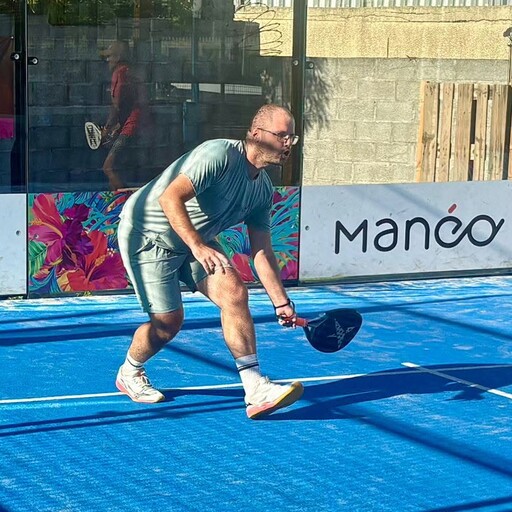
Padel is different. The court is shorter, but the glass walls force repeated short sprints, sudden direction changes off the back wall, and a lot of jumping for bandejas and viboras. The fatigue mode is more reactive-power-driven: the gastrocnemius and Achilles tendon take rapid eccentric loading, and cramps tend to come fast and sharp around the 75-90 minute mark.
What this means for calf cramps tennis match prevention: if you play both sports, train the calves both ways. Two weekly sessions of heavy slow eccentric calf raises for the endurance side (tennis), plus one session of plyometric pogo work for the reactive side (padel). Skip either and the missing pattern is where you will cramp first.
The pre-tournament 7-day taper for cramp-prone players
If you cramp every tournament regardless of fluids, run a deliberate taper the week before. Drop training volume 40% on days -7 to -4, drop to 20% on days -3 and -2, fully rest day -1. The point is to arrive at match day with calves that are fully repaired, fully glycogen-loaded, and neurologically fresh. Players who skip the taper because they want one more practice session almost always pay for it with cramps in the last set.
Selected research references
- Miller KC et al. (2010). Reflex inhibition of electrically induced muscle cramps in hypohydrated humans — MSSE
- Bergeron MF (2019). Exercise-associated muscle cramps — BJSM review
- Schwellnus MP (2009). Cause of exercise-associated muscle cramps
Bottom line
Calf cramps are not random. They are predictable, and they are preventable. Sleep, sodium, an eccentric calf primer, pickle juice on the first twitch, and percussion-plus-compression between matches will collapse your cramp incidence inside a single tournament weekend. Build the habit once, run it every time — your calves will give back the last set.