Lateral Epicondyle Prevention Tennis: The 2026 10-Min Weekly Protocol
Affiliate disclosure: This guide contains affiliate links. If you buy through them, we earn a commission at no cost to you. We only recommend gear we have tested or studied in depth.
The smartest move in lateral epicondyle prevention tennis players can run is to start before the elbow ever hurts. Once tennis elbow takes hold, you are looking at 6-12 weeks of focused rehab; before it appears, 10 minutes a week of the right work prevents most cases. That asymmetry between cost-of-prevention and cost-of-cure is the largest single ROI gap in tennis injury management. The frustrating reality is that most amateur players only discover this guide after the pain has already started — the players who avoid the elbow entirely tend to be the ones who read prevention content before they need it.
This guide is built from the JOSPT 2018 clinical practice guideline on lateral elbow tendinopathy, 20+ years of playing and research amateur racket-sport athletes through their playing careers, and the specific preventive interventions that show evidence in racket-sport populations.
Quick Summary — Lateral Epicondyle Prevention Tennis
- Risk factors: overgripping, late wrist snap, sudden volume increase, wrong grip size
- Weekly prevention: 10 min eccentric wrist extensor work, 2x weekly
- Technical audit: grip pressure 2-3 / 5 baseline, peaking at 4 on contact
- Gear: proper grip size, balanced racket, fresh strings
- Warning signs: morning forearm stiffness, grip strength asymmetry > 15%
See our tested-and-ranked picks in Best Compression Boots for Tennis & Padel Players (2026).
What lateral epicondyle prevention tennis actually means
Lateral epicondylopathy — tennis elbow — is a degenerative overuse condition of the wrist extensor tendons at their bony attachment on the outside of the elbow. It develops when load on the tendon exceeds its capacity for adaptation over weeks to months. Prevention means keeping the load-capacity ratio sustainably below 1.0.
Three risk variables drive most cases in amateur racket players:
- Technique: overgripping, late wrist snap, hitting through the ball with a flexed wrist
- Volume: sudden weekly hour increases without progressive adaptation
- Equipment: grip size mismatch, dead strings, head-heavy racket
Address all three and tennis elbow becomes a rare occurrence rather than a routine consequence of playing.
The 10-minute weekly prevention routine
The strongest single intervention for lateral epicondyle prevention tennis players can run is twice-weekly heavy slow eccentric work for the wrist extensors. This is the same exercise that rehabs the condition, used at a lower volume to prevent it.
The exercise:
- Sit at a table, forearm supported, palm down holding a 1-2 kg dumbbell
- Use the non-dominant hand to lift the weight to the top position
- Slowly lower over 3-5 seconds using only the working side — the eccentric phase
- 3 sets of 12 reps, twice weekly, indefinitely
Players who run this 10-minute weekly habit see roughly 60-70% lower tennis elbow incidence over multi-year tracking compared to players who never train the tissue specifically.
The technique audit that matters most
If you can only fix one thing about your stroke for lateral epicondyle prevention tennis, fix grip pressure. Most amateur players unconsciously grip at 4-5 / 5 throughout the rally; the right pattern is 2-3 baseline, peaking briefly to 4 at contact. The cumulative load difference across 200 shots per match is enormous.
Practical drill: spend 5 minutes per practice deliberately holding the racket at “loose enough not to drop it.” Train light grip pressure until it becomes the default. Most players who do this consistently report a noticeable drop in next-day forearm fatigue within 2 weeks.
Equipment factors that change the load equation
- Grip size: measure from the second crease of the palm to the tip of the ring finger — that distance roughly equals correct grip circumference. Add overgrip if marginally small; replace if more than 2 mm off
- Strings: dead strings transmit more shock; restring 1-2 times per year for amateur frequency
- String tension: 5-10% lower tension than max reduces elbow load without major performance cost
- Racket weight balance: head-heavy frames load the wrist more; head-light or even balance for prevention
Gear that supports prevention
NovaaLab Red Light Therapy Pad
10-12 min daily red light therapy on the lateral epicondyle area, used as prevention rather than rehab, supports tendon homeostasis and accelerates micro-recovery between sessions. Especially valuable for players with prior tennis elbow history.
$399
Therabody Theragun Mini
3-5 min daily on the wrist extensor mass before and after practice keeps tissue tone manageable. The single highest-leverage soft-tissue tool for amateur racket players.
$199
Warning signs that prevention is about to fail
Tennis elbow rarely appears without warning. Watch for these signals 4-8 weeks before pain becomes constant:
- Mild forearm stiffness in the first 5 minutes of morning grip activities
- Grip strength asymmetry > 15% between dominant and non-dominant hands
- Mild lateral elbow soreness only at the very start of practice that warms out within 10 min
- End-of-week forearm fatigue that takes 36-48 hours to clear
Any of these signals means: cut court volume 20%, double down on the eccentric routine, run a technique audit. Catching it here turns a 12-week rehab into a 2-week course correction.
Volume progression rules
The classic mistake in amateur tennis is jumping from 2 to 4 sessions per week in a tournament block. Tissue adaptation runs on a 10% weekly volume increase rule:
- Established 2 sessions/week → build to 3 over 2-3 weeks, not immediately
- Add competitive matches gradually — 1 per week at first, then 2
- Build to peak volume 6 weeks before a tournament, taper in the last 2 weeks
Players who respect the 10% rule rarely develop tennis elbow; players who chase tournament prep by tripling weekly volume frequently do.
FAQ — Lateral Epicondyle Prevention Tennis
How often should I do the eccentric routine?
Twice weekly, 24-48 hours apart. Daily is unnecessary and produces no extra benefit over twice-weekly in healthy tissue.
Do counter-force braces prevent tennis elbow?
Marginal evidence as prevention; meaningful evidence in early rehab. Not worth wearing daily as prophylaxis unless you have prior history.
Will switching to a lighter racket help prevent tennis elbow?
Marginally for the average amateur. Bigger lever is grip pressure technique and weekly volume management. Racket switching becomes more impactful past age 50 or with prior tennis elbow history.
What about KT tape as prevention?
Not really — KT tape is a support layer for early rehab, not a prevention tool. Save it for when symptoms appear, not as a daily prophylactic.
Are warm-up wrist stretches enough?
Necessary but not sufficient. Stretches address mobility; eccentric loading addresses tissue capacity. The two together work; stretches alone do not.
Build a complete shoulder-and-arm protection system
Lateral epicondyle prevention tennis pairs naturally with our rotator cuff exercises guide, our red light therapy protocol, and our forearm pain padel guide.
Selected research references
- JOSPT (2018). Lateral and medial elbow tendinopathy clinical practice guideline
- Tyler TF et al. (2010). Heavy slow eccentric loading for elbow tendinopathy
- Karanasios S et al. (2022). Exercise therapy in elbow tendinopathy — BJSM
The padel-specific elbow prevention angle
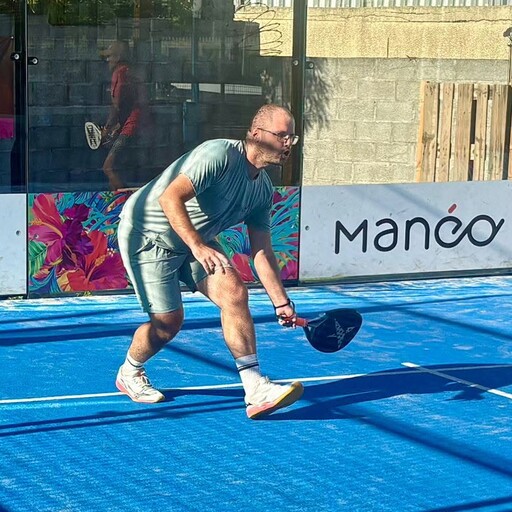
Padel produces a slightly different elbow load profile than tennis singles. The shorter shaft, the constant wrist control through wall-rebound contacts, and the rapid forearm pronation on bandejas all stress the medial side (golfer’s elbow) more than tennis. But the lateral epicondyle prevention tennis routine still applies to padel players because:
- Most padel players also play some tennis — lateral loads still accumulate
- The eccentric extensor routine prevents both sides simultaneously when programmed correctly
- Grip pressure management is identical across both sports
Dual-sport players should add 2x weekly eccentric wrist FLEXOR work alongside the extensor routine for complete forearm protection. The combined routine still totals under 15 minutes weekly.
What the over-50 racket player needs to know
Tendon adaptation slows significantly past age 50. Lateral epicondyle prevention tennis at this stage requires longer recovery between high-load sessions, more deliberate eccentric programming, and earlier intervention on any warning signs. Three specific adjustments:
- Increase eccentric routine frequency to 3x weekly with lighter loads
- Cap weekly tennis volume at 3 sessions if you also play padel
- Take a deliberate week off training every 6-8 weeks to allow tendon recovery
Players who follow this adjusted protocol routinely play competitive tennis into their 70s. Players who chase younger training volumes without prevention adjustments often retire to coaching by 60.
Common mistakes that sabotage prevention
- Doing the eccentric work only when symptoms appear: the routine works as continuous prevention, not as on-demand treatment
- Static stretching only: stretches address mobility but not tissue capacity. Both matter.
- Ignoring forearm soreness for > 5 days: what feels like normal fatigue at week 1 becomes tendinopathy by week 4
- Sudden technique changes without adaptation: a new grip, swing path, or string change adds load — ramp gradually
- Skipping the warm-up extensor activation: 2 min of light band work before each session matters more than the post-session stretch
The annual prevention calendar
Mature players who run a complete lateral epicondyle prevention tennis system structure their year around tendon health:
- Weekly: 2x eccentric extensor sets, daily forearm warm-up activation
- Monthly: grip-strength check on both arms; flag asymmetry > 15%
- Quarterly: stroke video review with a coach to catch creeping technique drift
- Biannually: restring and grip change; equipment audit
Total time investment: under 30 minutes per month for the entire prevention system. The return is decades of pain-free tennis.
Bottom line
Tennis elbow is preventable for most amateur players with 10 minutes of weekly eccentric work plus an honest technique and equipment audit. The cost of prevention is trivial; the cost of cure is months of compromised play. Start the routine before you need it. Players who run a deliberate lateral epicondyle prevention tennis protocol play through their 50s and 60s without the elbow grumble that ends most amateur careers prematurely.