Padel Elbow vs Tennis Elbow Differences: The 2026 Diagnostic Guide
Affiliate disclosure: This guide contains affiliate links. If you buy through them, we earn a commission at no cost to you. We only recommend gear we have tested or studied in depth.
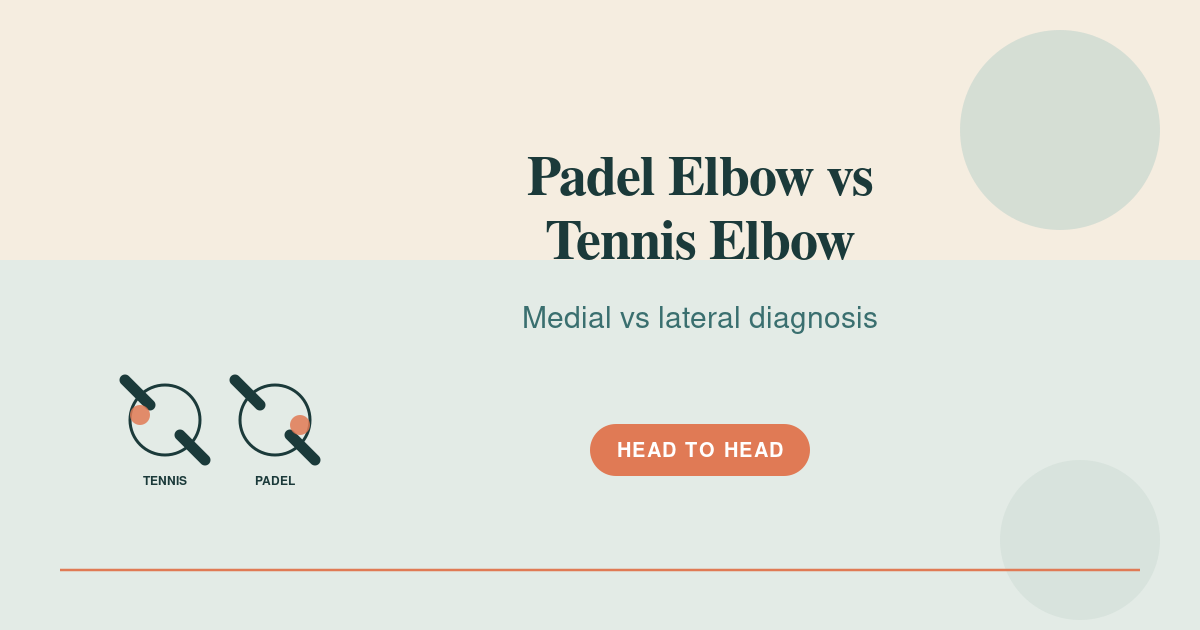
The padel elbow vs tennis elbow differences matter more than most amateur players realize, and the most common consequence of confusing the two is months of misdirected rehab. Tennis elbow is lateral epicondylopathy — the wrist extensors at the outer elbow. Padel elbow, while it can also be lateral, is much more frequently medial epicondylopathy — the wrist flexors at the inner elbow. Same elbow, opposite side, different protocol. Get the diagnosis wrong and you spend 8 weeks doing eccentric extensor work that doesn’t touch the actual injured tissue.
This guide pulls together the JOSPT 2018 clinical practice guideline on lateral and medial elbow tendinopathy, padel-specific medial elbow data from Spanish padel medical clinics, and the practical differences in technique drivers, rehab protocols, and gear recommendations.
Quick Summary — Padel Elbow vs Tennis Elbow Differences
- Tennis elbow (lateral): outer-elbow pain, wrist extensor tendinopathy
- Padel elbow (medial): inner-elbow pain, wrist flexor tendinopathy
- Tennis driver: late backhand wrist snap, gripping during impact
- Padel driver: sustained grip pressure, repeated pronation on bandeja
- Rehab mirror: same eccentric protocol but flipped (flexors vs extensors)
See our tested-and-ranked picks in Best Compression Boots for Tennis & Padel Players (2026).
The anatomical difference that drives everything
The elbow has two bony attachment points for wrist tendons:
- Lateral epicondyle (outer): origin of wrist extensors, particularly extensor carpi radialis brevis
- Medial epicondyle (inner): origin of wrist flexors, particularly flexor carpi radialis and pronator teres
Tennis elbow is overuse of the extensors at the lateral side. Padel elbow vs tennis elbow differences typically have the pain on the medial side — though padel can also produce lateral cases, the medial dominance is roughly 60-40 in Spanish clinic data.
Why padel produces more medial cases
Three mechanisms drive medial loading in padel:
- Sustained grip pressure: padel demands tight grip throughout strokes, not just at impact
- Forearm pronation on bandeja: the overhead-and-rotate pattern eccentrically loads the pronator teres at the medial elbow
- Continental grip wrist snap: the flexor mass works harder than in tennis groundstrokes
The cumulative load on the medial side per padel match exceeds what tennis groundstrokes produce on the lateral side, making medial epicondylopathy the more common padel elbow presentation.
How to tell which one you have
Three quick clinical tests to differentiate:
- Cozen’s test: resisted wrist extension reproduces lateral pain → tennis elbow
- Polk’s test: resisted wrist flexion reproduces medial pain → padel/golfer’s elbow
- Self-palpation: press the bony point on outer (lateral) vs inner (medial) elbow; the painful side identifies the condition
If both sides hurt, you have both conditions (yes, this happens in dual-sport players). Treat each side with its specific protocol.
The rehab protocols compared
The padel elbow vs tennis elbow differences extend into rehab. The good news: the framework is similar; the loading is mirrored.
Lateral tennis elbow protocol
- Eccentric wrist extension loading: palm-down position, slow lowering, 3 sets of 12, every other day
- Counter-force brace during match return
- Grip pressure technique audit
Medial padel elbow protocol
- Eccentric wrist FLEXION loading: palm-up position, slow lowering, 3 sets of 12, every other day
- Forearm pronation strengthening with light weight
- Same grip pressure audit but emphasizing pronation control
The exercises mirror each other — both target tendon adaptation through heavy slow eccentric loading. The difference is the wrist position.
Gear that supports both conditions
NovaaLab Red Light Therapy Pad
10-15 min daily red light therapy on the affected medial or lateral elbow accelerates tendon healing. Works equally well on both sides; just position the pad over the affected epicondyle.
$399
Therabody Theragun Mini
Daily forearm percussion on the flexor or extensor mass before the eccentric routine reduces tissue tension and improves tolerance to loading. Use on the affected side based on diagnosis.
$199
The dual-sport player complication
Many amateur racket players run both tennis and padel and develop both conditions simultaneously. The padel elbow vs tennis elbow differences become academic when both elbows hurt at once. Practical approach:
- Run both eccentric protocols 3x weekly each (about 15 min total)
- Cap weekly racket-sport volume during rehab
- Address grip technique on both sports simultaneously
- Return to one sport before the other; reintroduce volume gradually
Timeline differences worth knowing
Median return-to-sport timelines:
- Tennis elbow (lateral): 8-12 weeks with proper loading protocol
- Padel elbow (medial): 10-14 weeks — medial tendons heal slightly slower
- Combined cases: 14-18 weeks, requires patience and dual protocol
Players who try to shortcut the medial timeline by applying the tennis elbow timeline often re-injure and lose months.
Equipment factors that differ
- Tennis elbow: string tension, racket weight, grip size all matter
- Padel elbow: grip size and overgrip condition matter most; racket weight matters less
- Both: grip pressure technique is the upstream driver
FAQ — Padel Elbow vs Tennis Elbow Differences
Can I have both at once?
Yes — dual-sport players commonly do. Treat each side with its specific protocol.
Which is more common in padel players?
Medial (true padel elbow) accounts for roughly 60% of padel clinic cases; lateral 40%.
Are counter-force braces the same for both?
Position the brace below the affected epicondyle. Lateral elbow brace goes on the outer forearm; medial brace goes on the inner forearm.
Should I get an MRI?
Usually unnecessary for typical presentations. Reserve for failed 8+ weeks of conservative rehab or suspected ulnar nerve involvement.
How long until I can play after diagnosis?
Light hitting at week 6-8, competitive match return at 10-14 weeks depending on side and grade.
Build a complete elbow and forearm system
Padel elbow vs tennis elbow differences pair naturally with our tennis elbow recovery guide, our forearm pain padel guide, and our red light therapy protocol.
Selected research references
- JOSPT (2018). Lateral and medial elbow tendinopathy clinical practice guideline
- Karanasios S et al. (2022). Exercise therapy in elbow tendinopathy — BJSM
- Tyler TF et al. (2010). Heavy slow eccentric loading for elbow tendinopathy
The technique audit that prevents both
Once you identify which type you have, the upstream prevention is similar: grip pressure technique. Tennis elbow drives from late wrist snap with extension; padel elbow drives from sustained flexion and pronation. The fix in both cases is loosening grip pressure to 2-3/5 baseline and peaking only briefly at impact. Players who genuinely change grip pressure habits rarely develop either condition.
Volume management long-term
Both conditions stay vulnerable for 6-12 months post-recovery. Maintenance routines:
- 2x weekly eccentric work for the affected side (or both for dual-sport players)
- Daily 3-min forearm mobility flow
- Quarterly equipment audit
- Annual grip strength check (target > 90% symmetry between sides)
What the sports physician sees
A sports physician evaluating padel elbow vs tennis elbow differences runs the same general workup: history, palpation, resisted tests, ultrasound if persistent. Imaging is reserved for atypical presentations. Conservative management succeeds in 80-90% of amateur cases; surgical referral applies only to failed 6+ months of conservative care or imaging-confirmed full tendon rupture.
The biomechanical detail of padel grip flexion
The padel elbow vs tennis elbow differences trace back to a specific biomechanical pattern: padel demands constant wrist flexion strength to control the racket against unpredictable ball flights from wall rebounds. Tennis groundstrokes have predictable contact points; padel does not. The wrist flexors fire continuously to adjust racket angle in micro-corrections that tennis does not require. Across a 90-minute match, that cumulative flexor load greatly exceeds anything tennis groundstrokes produce.
Three flexor-loading patterns to be aware of in padel:
- Wall rebound adjustment: reactive flexor firing to control ball angle
- Bandeja pronation control: the rotation-and-snap pattern loads pronator teres specifically
- Volley control at the net: sustained light flexion through long volleys
The dominant hand check
One subtle piece of padel elbow vs tennis elbow differences: both conditions affect the dominant arm, but tennis singles produces more symmetric load (both arms contribute) than padel doubles. Padel doubles concentrates all stroke load on one arm exclusively. The result: padel players develop unilateral medial epicondylopathy faster than tennis players develop unilateral lateral epicondylopathy. Tennis players with bilateral racket handling (two-handed backhand) often spread load more evenly than padel players.
What the sport progression should look like during recovery
Players returning from either tennis or padel elbow should respect a sport-specific volume progression:
- Week 6: light hitting drills, no full matches
- Week 7-8: practice match at 70% intensity
- Week 9-10: practice match at full intensity
- Week 10+: competitive match if criteria pass
Most amateur players who recurrent within 6 months had skipped the week 6-8 volume ramp. Respect it.
The recurrence pattern in dual-sport players
Players who recurrent within 6 months in dual-sport (tennis + padel) populations almost always do so because they reintroduce both sports simultaneously after rehab. The padel elbow vs tennis elbow differences mean each side carries its own re-injury risk. Best practice: return to one sport at a time, building 4 weeks of pain-free play before reintroducing the second sport. This staggered approach reduces recurrence rates significantly.
Bottom line
Tennis elbow and padel elbow are mirror conditions of the same anatomical region. Diagnose correctly, apply the side-specific eccentric loading protocol, address grip pressure technique, layer red light therapy and percussion. Players who understand the padel elbow vs tennis elbow differences upfront avoid months of misdirected rehab and return to court faster.