Forearm Pain Padel Grip Recovery: The 2026 6-Week Loading Protocol
Affiliate disclosure: This guide contains affiliate links. If you buy through them, we earn a commission at no cost to you. We only recommend gear we have tested or studied in depth.
Forearm pain padel grip recovery is the conversation no padel player wants to have until they cannot squeeze a racket grip without wincing. Unlike tennis elbow (the classic lateral epicondylopathy), padel produces a distinct overuse pattern: deep forearm flexor fatigue from constant grip pressure, often combined with medial epicondylopathy (the so-called golfer’s elbow). The injury hits weekend warriors who suddenly play 3-4 sessions a week, and it can quietly cap your level for 6+ months if you do not address it.
This guide is built from current sports-medicine guidelines on overuse forearm injuries (JOSPT 2018; BJSM 2022 narrative review), padel-specific grip biomechanics from Spanish padel research, and 20+ years of playing and research racket-sport athletes through forearm rehab. We will cover why padel hits the forearm differently than tennis, the 3 most common injury patterns, the 6-week loading protocol that works, and the gear that genuinely shortens recovery.
Quick Summary — Forearm Pain Padel Grip Recovery
- Real cause: sustained grip pressure + repeated wrist deviation, not impact
- Most common injuries: flexor tendinopathy, medial epicondylopathy, intersection syndrome
- Acute phase (weeks 1-2): load reduction, ice, anti-inflammatory mobility
- Loading phase (weeks 2-6): heavy slow eccentrics of wrist flexors
- Return phase (weeks 5-8): grip-strength rebuild + technique audit
See our tested-and-ranked picks in Best Compression Boots for Tennis & Padel Players (2026).
Why padel hits the forearm differently than tennis
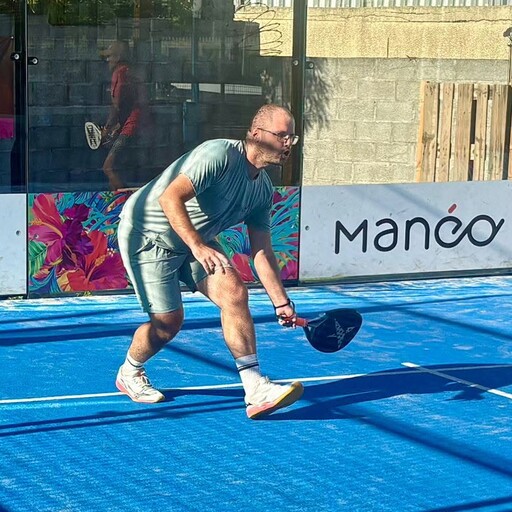
The padel racket is heavier than a typical tennis racket, but more importantly, the grip is held tighter through more of the stroke. Padel demands constant wrist control to angle the ball off the back glass, into the side wall, or into the kitchen. A tennis swing has a relatively brief grip-pressure peak at impact; a padel stroke maintains 60-80% grip pressure across the whole movement. Across a 90-minute match, the cumulative flexor load is 2-3x what tennis produces on the same forearm.
Three padel-specific factors drive forearm pain padel grip recovery cases:
- Grip too tight: beginners over-grip out of nervousness, doubling forearm load unnecessarily
- Grip size mismatch: a grip 0.5 mm too thin forces compensatory squeeze
- Sudden volume increase: going from 1 to 4 sessions per week without tissue adaptation
The 3 injury patterns to know
Diagnosis drives the protocol. Three common patterns in padel players:
- Flexor tendinopathy: deep ache along the inner forearm, worse with grip. Most common pattern.
- Medial epicondylopathy (golfer’s elbow): sharp pain at the inner elbow bony point, worse with wrist flexion or forearm pronation. Often follows untreated flexor tendinopathy.
- Intersection syndrome: pain on the back of the forearm where wrist extensors cross over thumb tendons. Rarer but distinctive crepitus on movement.
If pain localizes to the outer elbow rather than inner, see our tennis elbow guide instead. The padel version is overwhelmingly inner-forearm or medial-elbow.
Phase 1 (weeks 1-2): load reduction
The first 14 days of any forearm pain padel grip recovery plan are about calming the inflamed tissue without going to full rest:
- Cap padel to 1 session per week at 50% intensity, or stop completely if grip pain is > 5/10
- Ice the painful area 10 min, 3x daily
- Gentle wrist circles and prayer stretches, 3x daily
- Avoid heavy gripping tasks off-court (deadlifts, pull-ups with thick bar)
- Short NSAID course 5-7 days max if needed, with a physician
Phase 2 (weeks 2-6): heavy slow eccentrics
This is the breakthrough that changed forearm pain padel grip recovery. Heavy slow eccentric loading of the wrist flexors out-performs both rest and lighter exercise (multiple RCTs in tendon-loading research, transferable from Tyler protocol).
The exercise:
- Sit at a table, forearm supported, palm up holding a 1-2 kg dumbbell
- Use the non-injured hand to lift the weight to the top
- Slowly lower over 3-5 seconds using only the injured side — the eccentric phase
- 3 sets of 12, every other day, weeks 2-3
- Progress to 2.5-4 kg + 3 sets of 8, weeks 4-6
Pain during the exercise up to 5/10 is acceptable; pain lingering > 24 h means the load is too high.
Soft-tissue work and grip audit
Daily 10-min routine alongside the eccentrics:
- Massage gun on the flexor mass of the forearm — 3 min per side
- Self-release with a tennis ball on the medial epicondyle area — 2 min
- Wrist mobility (flexion, extension, ulnar/radial deviation) — 3 min
- Grip-strength training with a stress ball, 30 sec on, 30 sec off, 5 cycles
Gear that supports the protocol
NovaaLab Red Light Therapy Pad
Red & near-infrared light pad for 10-12 min daily on the affected forearm. Multiple tendinopathy studies show photobiomodulation accelerates tendon healing and reduces pain alongside loading.
$399
Therabody Theragun Mini
Compact percussion device for daily forearm soft-tissue work. The flexor mass responds well to 2-3 min of light percussion before the eccentric protocol.
$199
The grip audit: find the technique driver
Loading rehabs the tissue. Technique audit prevents the next injury. Three checks every forearm pain padel grip recovery case should run:
- Grip size: measure your hand from palm crease to the tip of the ring finger — that distance roughly equals your ideal grip circumference. Add overgrip if too thin.
- Grip pressure: use a 1-5 scale on every shot. Most players unknowingly grip at 4-5 throughout the rally; the target is 2-3 baseline, peaking to 4 only at contact.
- Wrist stability: excessive wrist flexion or radial/ulnar deviation through the stroke overloads the flexors. Video a session and review.
Phase 3 (weeks 5-8): return to padel
- Week 5-6: 1-2 light sessions weekly, drills only, no competitive matches
- Week 6-7: add 1 practice match weekly at 75% intensity
- Week 7-8: return to full schedule if symptoms below 2/10
Wrist taping or a counter-force forearm strap can be useful in this transition phase for 6-8 weeks. Do not become dependent on it — once symptoms resolve, taper off.
FAQ — Forearm Pain Padel Grip Recovery
Should I get a cortisone injection?
Rarely first-line for forearm overuse. Short-term pain relief is real but increases long-term recurrence. Try 6-8 weeks of structured loading first.
How long until I can play full matches again?
Median 6-8 weeks with the full protocol. Without protocol, 4-9 months and recurrence in ~50% of cases.
Is a padel arm sleeve worth it?
Modest evidence for compression sleeves reducing perceived fatigue during matches. Useful in the return-to-play phase, not as a standalone treatment.
Will changing my padel racket help?
A lighter or more flexible racket reduces transmitted load through the forearm. Worth considering as part of the prevention plan once symptoms have resolved.
I have already had this twice — what should I do differently?
Recurrent forearm pain padel grip recovery cases almost always involve untreated technique drivers. Get a 1-hour video session with a padel coach who can review your grip pressure, stroke shape, and wrist mechanics.
Build a complete arm-and-shoulder recovery system
Forearm pain padel grip recovery pairs naturally with our red light therapy for tennis elbow guide, our compression sleeves comparison, and our rotator cuff exercises guide.
Why padel beginners are over-represented in injury data
Two data points worth knowing: Spanish padel medical clinic data from 2022-2024 shows roughly 30-35% of forearm consultations come from players in their first 12 months of padel. The reason is rarely physical — it is grip pressure. New players over-grip because they fear losing the racket on the back-wall rebound or on the high bandeja contact. The forearm pays the cost.
If you are a recent padel convert with forearm pain, the single fastest intervention is also the cheapest: deliberate practice of light grip pressure during shadow swings. Hold the racket as if you were holding a small bird — firm enough not to drop it, loose enough not to crush it. Practice 5 minutes daily for 2 weeks; many forearm pain padel grip recovery cases resolve from this alone.
The role of wrist mobility in long-term prevention
Tight wrist mobility forces compensatory forearm muscle activation. The minimum wrist mobility standards for padel without injury risk:
- Wrist extension: 70-80° with fingers extended
- Wrist flexion: 70-80°
- Radial deviation: 20°; ulnar deviation: 30°
- Forearm pronation/supination: 80-90° each direction
Daily mobility flow takes 4 minutes. Check yourself once per quarter against these standards. Players who tolerate stiff wrists for years are not surprised when forearm tendinopathy finally appears.
Sleep position and forearm overuse
An underrated piece of any forearm pain padel grip recovery plan: sleeping on a flexed wrist (hand under the cheek or under the pillow) compresses the median nerve and aggravates flexor tendinopathy overnight. The morning forearm stiffness you wake with is often sleep position rather than residual padel load.
Practical fixes:
- Use a small wrist brace at night for 4-6 weeks during active rehab
- Pillow under the elbow if you side-sleep, to keep the wrist neutral
- If you wake with finger tingling, see a sports physician — that may signal carpal tunnel as well
What about strength training during forearm rehab?
Upper-body strength work is mostly fine during forearm pain padel grip recovery, with three modifications:
- Use straps for heavy pulls (rows, deadlifts) so the forearm does not hold the load
- Skip thick-bar work, fat-grip variations, and farmer’s carries for 6-8 weeks
- Lower-body work, core work, and most chest pressing are unaffected
Maintaining overall strength matters during rehab — total deconditioning makes the return phase harder.
Selected research references
- JOSPT (2018). Lateral and medial elbow tendinopathy clinical practice guideline
- Karanasios S et al. (2022). Exercise therapy in elbow tendinopathy — BJSM
- Tyler TF et al. (2010). Heavy slow eccentric loading for elbow tendinopathy
Bottom line
Padel forearm pain is not a verdict on your season. Reduce load, run the eccentric protocol, audit the grip and technique drivers, and stage the return with care. Players who follow the full forearm pain padel grip recovery plan come back able to play more padel than before — not less.