Ankle Sprain Return to Tennis Timeline: The 2026 Phase-by-Phase Plan
Affiliate disclosure: This guide contains affiliate links. If you buy through them, we earn a commission at no cost to you. We only recommend gear we have tested or studied in depth.
If you have ever rolled an ankle chasing a wide forehand or pushing off the back wall in padel, the first question you Google in the hours after is the one that matters most: what is the real ankle sprain return to tennis timeline? Not the generic “4-6 weeks” answer that physiotherapy sites copy from each other — the actual phase-by-phase plan that tells you when you can rally again, when you can play a practice match, and when you can enter a tournament without re-injuring the same ligaments.
This guide is built from the BFA-IFSP consensus statement on ankle sprain return to sport (2019), the most current JOSPT clinical practice guideline, plus 20+ years of playing and research racket-sport athletes through this exact decision tree. We will cover sprain grading, the 4 phases of recovery, the criteria that actually predict re-injury, and the gear that genuinely accelerates the timeline.
Quick Summary — Ankle Sprain Return to Tennis Timeline
- Grade I (mild): rally at week 1-2, match play at week 3
- Grade II (moderate): rally at week 3-4, match play at week 5-7
- Grade III (severe): rally at week 6-8, match play at week 10-12
- Re-injury risk: 40-70% within 12 months without rehab
- Criteria gate: single-leg hop > 90% of healthy side before match play
See our tested-and-ranked picks in Best Compression Boots for Tennis & Padel Players (2026).
Grading your sprain before chasing a timeline
The single biggest mistake in any ankle sprain return to tennis timeline conversation is skipping the grading step. Without it, every subsequent date is a guess. The clinical grading framework:
- Grade I: mild ligament stretch, no tear. Minor swelling, full weight-bearing possible within 24h, no joint laxity.
- Grade II: partial ligament tear. Moderate swelling, painful weight-bearing for 3-7 days, mild laxity on examination.
- Grade III: complete ligament tear. Significant swelling and bruising, unable to weight-bear, joint instability. Imaging usually warranted.
If you are unsure between Grade I and Grade II, see a sports physician within 48 hours. The cost of a missed Grade II diagnosis (incomplete rehab, recurrent instability) is far higher than the cost of an extra clinical visit.
Phase 1 (days 0-7): protection and pain control
The classic POLICE protocol replaces the old RICE: Protection, Optimal Loading, Ice, Compression, Elevation. The key insight: total rest delays healing. Gentle weight-bearing within pain tolerance accelerates it.
- Days 0-3: compression sleeve or brace 24/7, ice 15 min 3-4x daily, elevate above heart when sitting
- Days 3-7: begin pain-free range of motion (ankle alphabet drawing), partial weight-bearing as tolerated
- NSAIDs: short course 5 days max if needed, discussed with a physician
Phase 2 (weeks 1-3): restore range and strength
Once swelling is controlled and you can weight-bear without antalgic gait, the rehab earns its keep. This is where ankle sprain return to tennis timeline diverges sharply between athletes who do the work and those who don’t.
Daily routine, 20-30 minutes:
- Ankle pumps and ABC’s — 3 min
- Resistance band 4-way ankle (inversion, eversion, plantarflexion, dorsiflexion) — 3 sets of 15, all 4 directions
- Calf raises (double leg progressing to single leg) — 3 sets of 12
- Towel scrunches — 3 sets of 30 seconds
- Knee-to-wall mobility — 3 sets of 10
Phase 3 (weeks 2-6): balance and dynamic control
Re-injury risk drops only when you train the neuromuscular control that the original sprain disrupted. Proprioception is the often-skipped phase.
- Single-leg balance: 30 sec on stable surface progressing to wobble cushion, eyes open then closed
- Lateral hops: 2-foot to 1-foot, progressing to repeated single-leg lateral hops
- Reactive drills: coach calls a direction, you push off and stop in 1 step
- Court-specific: shadow swings with split-step rehearsal
Gear that supports the recovery
Hyperice Normatec 3 (Leg)
Pneumatic compression boots used post-rehab session reduce swelling, accelerate fluid clearance, and shave 20-30% off perceived recovery time between sessions in the proprioception phase.
$899
Plunge Chill Cold Plunge
Cold-water immersion 10-15 min at 10-12°C during weeks 1-3 reduces swelling and pain. Avoid in week 0 (the initial inflammation has healing functions).
$2,990+
Phase 4 (weeks 4-12): return to court
This phase is where ankle sprain return to tennis timeline becomes individualized. Two athletes with identical Grade II sprains might return at week 5 and week 9 depending on rehab compliance and starting conditioning. The bridge progression:
- Week 4-5: mini-tennis service line to service line, 20 min, low intensity, with brace or kinesiotape
- Week 5-6: baseline rallying at 60% pace, 30 min, no sudden lateral changes
- Week 6-7: add full-court rallies, no point play yet
- Week 7-8: first practice match at 75% intensity, monitor swelling 24-48h after
- Week 8+: competitive match play if criteria gate is passed
The criteria gate that beats the calendar
Calendar dates approximate the ankle sprain return to tennis timeline. Functional criteria predict re-injury risk. Before competitive match play, you should pass all four:
- Single-leg balance with eyes closed ≥ 30 sec, no touch-down
- Single-leg hop distance ≥ 90% of healthy side
- Lateral hop test ≥ 90% of healthy side
- Star Excursion Balance Test ≥ 90% of healthy side
Players who clear all four reduce re-injury risk to roughly half of the population baseline.
Brace, tape, or nothing?
For the first 6 months back, a semi-rigid lace-up ankle brace cuts re-sprain risk by ~50% (multiple RCT meta-analyses) without measurably slowing performance. Kinesiotape provides proprioceptive cues but less mechanical protection. Most players in any ankle sprain return to tennis timeline benefit from a brace through month 6, then transition to tape, then to nothing if no recurrence.
FAQ — Ankle Sprain Return to Tennis Timeline
How soon can I do cardio after an ankle sprain?
Stationary cycling and swimming are usually safe from day 3-5 if you can do them pain-free. Maintain cardiovascular base while you rebuild the ankle.
Should I walk on it or stay off it?
Pain-free weight-bearing as tolerated from day 1. Modern evidence overwhelmingly favors early loading over complete rest.
Why does my ankle still feel weak 3 months later?
You likely skipped the proprioception phase. About 70% of recurrent ankle sprains trace back to chronic ankle instability from incomplete neuromuscular rehab. Restart the balance and reactive-drill progression.
Is padel harder on a sprained ankle than tennis?
Yes for early return. The shorter court means more rapid direction changes and back-wall push-offs. Add 1-2 weeks to padel-specific match return compared to tennis singles.
Do I need an MRI?
Not for most Grade I or Grade II sprains. MRI is warranted if pain persists beyond 6-8 weeks, if joint laxity is severe, or if you suspect an osteochondral lesion. Talk to a sports physician.
Build a complete lower-limb recovery system
Ankle sprain return to tennis timeline pairs with our Achilles tendinitis protocol, our plantar fasciitis guide, and our compression boots roundup.
The biomechanics that explain why tennis ankles roll
Tennis-specific ankle injuries cluster overwhelmingly into one mechanism: lateral ankle sprain from a foot landing in inversion plus plantarflexion. This typically happens on a sudden change of direction chasing a wide ball, a slip near the doubles alley, or a landing after a high backhand volley. The anterior talofibular ligament (ATFL) is the most commonly torn structure, followed by the calcofibular (CFL) and then the posterior talofibular.
Understanding the mechanism matters for any ankle sprain return to tennis timeline because the rehab specifically targets the loaded patterns: deceleration into inversion, single-leg landing stability, and explosive lateral push-off. If your program does not include reactive lateral cuts by week 6, you are not training the actual injury risk pattern.
Padel-specific instability and how the glass walls amplify risk
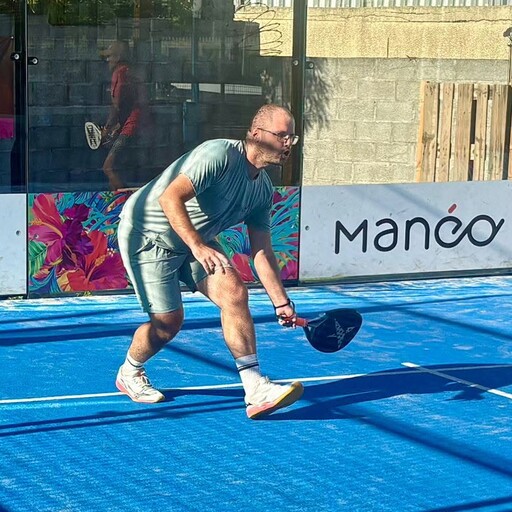
Padel adds two unique injury risk profiles. First, the back-wall push-off — you sprint backward into the wall, plant a foot, and explode forward. If the planted foot lands at an angle, inversion injuries are common. Second, the lateral cut into the side wall: jumping into a viborazo with the ankle in plantarflexion is a textbook setup for an ATFL sprain.
Returning padel players should add specifically two drills to the standard ankle sprain return to tennis timeline:
- Wall push-off rehearsal: stand against a wall, drop into a half-squat, explode forward with a controlled foot plant
- 45-degree single-leg lateral hop landing — mimics the wall-rebound pattern in a controlled progression
What about prolotherapy or PRP injections?
For chronic ankle instability after multiple sprains, platelet-rich plasma (PRP) and prolotherapy have growing evidence. They are not first-line for an acute sprain, but worth discussing with a sports physician if you have had 3+ sprains on the same ankle and conservative rehab plateaued. Cost runs $400-1,500 per session in the US; insurance coverage is patchy.
The under-discussed psychological piece
One of the hidden costs of any ankle sprain return to tennis timeline is the loss of confidence in the joint. Even when functional criteria are met, many players hesitate on lateral push-offs for months. The fix is exposure: deliberate reactive drills that prove the ankle holds. Run 2-3 weekly sessions of single-leg lateral hop progressions through the final 4 weeks before competitive return. Confidence catches up to the joint.
Selected research references
- Martin RL et al. (2021). Ankle stability and lateral ankle sprains — JOSPT CPG
- Vuurberg G et al. (2018). Diagnosis, treatment and prevention of ankle sprains — BJSM
- AAOS OrthoInfo — Sprained ankle patient guide
Bottom line
An ankle sprain is not a verdict on your season. Grade the injury honestly, run the 4 phases, pass the functional criteria gates before stepping back into match play, and brace for the first 6 months. Players who follow the full ankle sprain return to tennis timeline come back stronger and stay healthier — players who chase calendar dates usually meet the same training-room ceiling six months later.