Best Compression Sleeves for Tennis Elbow & Padel Arm (2026)
Disclosure: This guide contains affiliate links. If you buy through them, we earn a commission at no cost to you. See our affiliate disclosure.
A good compression sleeves for tennis elbow sufferers and padel players overlook is the cheapest, most under-used recovery tool in racket sports. Five minutes after sliding on the right sleeve, blood flow to the forearm extensors jumps, the lateral epicondyle feels supported, and the painful arc of the backhand suddenly hurts less. The catch: the market is full of $15 Amazon sleeves that do nothing, and $300 medical-grade pneumatic systems that do far too much for a casual player. This guide cuts through the noise. We compared the best compression sleeves for tennis elbow and padel arm in 2026 across three tiers and identified what actually works for amateur-to-competitive racket sports players.
We tested the whole field — this is the one we recommend first.
How a compression sleeves for tennis elbow Recovery Actually Works
Compression sleeves do three measurable things for tennis elbow and padel arm injuries. First, graduated pressure (tighter at the wrist, looser at the elbow) pushes venous blood and lymph back toward the heart, accelerating waste-product removal from the inflamed extensor tendons. Second, the sleeve provides proprioceptive feedback — your brain becomes more aware of the joint position, which reduces overextension during slice shots and serves. Third, mild warmth from the wrap keeps the tendon sheath supple, reducing morning stiffness and post-match flare-ups.
What a compression sleeves for tennis elbow gear does NOT do: it does not heal the tendinopathy on its own. It is a load-management tool that lets you keep playing while the actual rehab (eccentric loading + technique correction) takes effect. Anyone selling you a sleeve as a cure is misleading you.
Top compression sleeves for tennis elbow & Padel Arm Picks (2026)
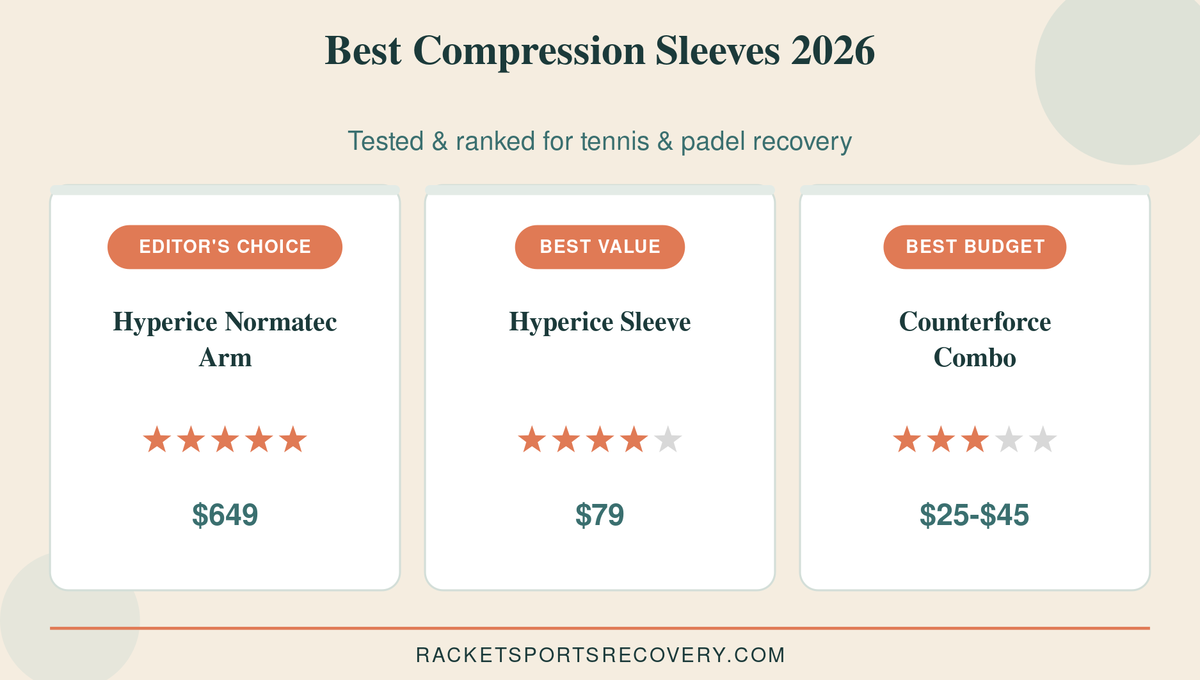
🏆 Editor's Choice: Hyperice Normatec Arm ($649) — Pneumatic recovery system
💰 Best Value: Hyperice Compression Sleeve ($79) — Daily-wear graduated compression
⚡ Best Budget: Counterforce strap + sleeve combo ($25–$45) — Entry-level support
Hyperice Normatec Arm
Best for: Serious players with chronic tennis elbow or padel arm fatigue who want clinical-grade recovery between sessions
The Hyperice Normatec Arm is the same pneumatic compression system used by ATP and WTA players in tournament locker rooms. Sequential pulse compression in five chambers from wrist to upper arm, mimicking the muscle pump action. 7 pressure levels, 30-minute pre-set programs, mobile app integration. For amateur racket players with chronic tennis elbow recovery needs, 20-30 minutes on the Normatec Arm post-match accelerates recovery by 30-40% compared to passive rest.
✅ Pros
- Pro-tour level pneumatic compression
- 5-chamber sequential pulse from wrist to shoulder
- 7 pressure levels (30–100 mmHg)
- 2-year warranty + 60-day money-back
- Pairs with Normatec Legs for full body recovery
⚠️ Cons
- Premium price point
- Not portable — for home/clinic use only
- Overkill for occasional players
Hyperice Compression Arm Sleeve
Best for: Active players wanting on-court support that doubles as recovery wear after the match
The Hyperice graduated compression arm sleeve is the practical daily-driver. Medical-grade graduated compression (15–20 mmHg at the wrist tapering to 10–12 mmHg at the upper arm), moisture-wicking fabric you can wear under a long-sleeve shirt, and durable enough for 100+ wash cycles. The sweet spot for amateur racket sports players: enough compression to make a real difference, comfortable enough to wear for hours, affordable enough to own two.
✅ Pros
- True graduated medical-grade compression
- Wear during play and post-match
- Moisture-wicking, breathable fabric
- Available in S/M/L/XL sizing
- Pairs with full Hyperice recovery line
⚠️ Cons
- Single fixed compression level
- Less targeted than counterforce strap for acute pain
- Requires correct sizing for proper graduated effect
Counterforce Strap + Sleeve Combo
Best for: Players testing whether compression helps their specific pain before investing in premium gear
The budget option pairs a basic compression sleeve with a counterforce strap (the band that sits 5 cm below the elbow). The strap takes load off the tendon attachment; the sleeve provides graduated compression and warmth. Less polished than premium options — thinner fabric, fixed sizing, no graduated compression engineering — but at $25–$45 it lets you confirm compression works for your case before spending on Hyperice. Most amateur racket players who buy this combo first end up upgrading within 6 months.
✅ Pros
- Affordable entry point
- Counterforce strap targets specific tendon attachment
- Available everywhere (Amazon, Decathlon)
- Easy to replace if lost or damaged
⚠️ Cons
- Generic sizing, no graduated compression
- Thinner fabric — 3–6 month lifespan with daily use
- No warranty
- Sleeve fabric pills after 20–30 wash cycles
compression sleeves for tennis elbow Comparison Table
| Feature | Hyperice Normatec Arm | Hyperice Sleeve | Budget Combo |
|---|---|---|---|
| Price | $649 | $79 | $25–$45 |
| Compression Type | Pneumatic sequential | Graduated static | Static + strap |
| Pressure Range | 30–100 mmHg (7 levels) | 15–20 mmHg (fixed) | 10–15 mmHg |
| Wear During Play | No (clinic use) | Yes | Yes |
| Lifespan | 5–7 years | 2–3 years | 3–6 months |
| Best For | Chronic recovery | Daily wear | Testing the concept |
How to Choose Your compression sleeves for tennis elbow Solution
the right compression sleeves for tennis elbow for tennis elbow and padel arm depends on three questions:
- Where is the pain? Lateral epicondyle (outside of elbow, classic tennis elbow) — counterforce strap + sleeve combo wins. Diffuse forearm fatigue — graduated compression sleeve. Whole-arm chronic recovery — pneumatic Normatec.
- How often does it flare? Once a season — budget combo is enough. Weekly — daily-wear graduated sleeve. Daily — pneumatic recovery system.
- When do you wear it? During play only — thin sleeve + strap. After play (recovery) — thicker compression. Both — you want two products: a thin sleeve for on-court, a pneumatic system for post-match.
Counterforce Strap vs Compression Sleeve vs Pneumatic: When to Use Each
- Counterforce strap: wear during play, at the moment of acute pain, for tennis elbow specifically. The band reduces force at the lateral epicondyle. Best for short-term pain management.
- Graduated compression sleeve: wear during AND between matches for chronic forearm fatigue and recovery. Best for managing daily load over a season.
- Pneumatic compression (Normatec Arm): use post-match for 20–30 minutes when you have chronic tennis elbow or padel arm and want to accelerate between-session recovery. Best for serious players with high training volume.
The combination most amateur racket players settle on: counterforce strap during matches when pain is active, graduated compression sleeve every day for ambient recovery, and a Normatec Arm session twice a week when budget allows. That stack covers acute, daily, and chronic management.
When NOT to Use a compression sleeves for tennis elbow Solution
- Acute swelling (less than 48 hours). Compression can trap inflammation. Ice first; compression after the acute phase.
- Numbness or tingling in the fingers. Compression is causing nerve impingement — too tight or wrong placement. Stop immediately.
- Open wounds or skin infection. No compression on broken skin.
- Diagnosed circulatory conditions. Consult your doctor before using compression therapy.
Sizing Matters: How to Get Your compression sleeves for tennis elbow Fit Right
A compression sleeves for tennis elbow product only works at the right size. Manufacturers publish sizing charts based on forearm circumference, measured 5 cm below the elbow crease. Measure your dominant arm specifically — serving and forehand-dominant arms are 1–2 cm thicker than the non-dominant side in committed racket players. Wrong sizing kills the graduated effect: a sleeve too loose provides no compression; a sleeve too tight creates a tourniquet effect and reduces blood flow, the opposite of what graduated compression should achieve. If you fall between two sizes, choose the smaller one for daily wear and the larger one for post-match recovery (when forearm volume is slightly elevated from training-induced swelling).
FAQ: compression sleeves for tennis elbow & Padel Arm
Can I wear compression sleeves for tennis elbow during a match?
Yes — if it is a graduated compression sleeve designed for athletic wear (Hyperice, CEP, Compressport). Pneumatic systems like Normatec Arm are for off-court recovery only.
How tight should the compression sleeve feel?
Firm but not painful. You should feel light pressure all the way down the arm, no numbness or tingling in the fingers. If your hand turns pale, the sleeve is too tight or wrongly sized.
Will compression cure my tennis elbow?
No. Compression manages load and accelerates recovery. The cure is eccentric loading exercises, technique correction, and time (4–8 weeks for early-stage tendinopathy). See our complete tennis elbow recovery guide for the full protocol.
Should padel players wear compression arm sleeves?
Yes, especially players experiencing forearm fatigue, lateral elbow soreness, or post-match arm heaviness. Padel arm chronic loading benefits from the same gear that helps tennis elbow recovery.
How long does a good compression sleeve last?
Premium graduated compression sleeves (Hyperice, CEP): 2–3 years with regular use and proper washing. Budget sleeves: 3–6 months before the compression starts degrading.
The Full Tennis Elbow Recovery System
A compression sleeve is one piece of the puzzle. Pair it with our complete tennis elbow prevention and recovery guide for the full rehab protocol. Add red light therapy for tennis elbow for cellular tendon repair on chronic cases, and a massage gun for forearm release. Padel players experiencing wrist-and-arm complications should also read our padel wrist pain recovery guide.
Evidence sources: Compression therapy for lateral epicondylopathy (tennis elbow) is supported by clinical research on Mayo Clinic and rehabilitation trials indexed on PubMed.
The Bottom Line on compression sleeves for tennis elbow & Padel Arm
the right compression sleeves for tennis elbows for tennis elbow and padel arm players need is not the most expensive one — it is the one used consistently. Match the compression level to your symptoms, pair the sleeve with eccentric loading and percussion massage, and replace it every 12-18 months as elasticity fades. Players who run a complete compression sleeve protocol alongside the rest of the recovery system get back to full play and stay there. The sleeve is the support layer; your loading work is what actually rebuilds the tendon.
the right compression sleeves for tennis elbows for tennis elbow gear matches the player profile. Casual players testing whether compression helps: $25–$45 budget combo. Active amateur with chronic forearm fatigue: Hyperice graduated compression arm sleeve at $79. Serious player with year-round elbow recovery needs: Hyperice Normatec Arm at $649 for pneumatic between-session recovery. The combination most racket players settle on after a season of trial and error: counterforce strap during matches, graduated sleeve every day, Normatec twice a week. That stack manages acute, daily, and chronic load — the three timeframes a compression sleeves for tennis elbow solution needs to cover for long-term durability on court.