KT Tape Tennis Elbow Application Guide: The 2026 4-Strip Protocol
Affiliate disclosure: This guide contains affiliate links. If you buy through them, we earn a commission at no cost to you. We only recommend gear we have tested or studied in depth.
If you have ever watched a tennis match and noticed those colorful strips on a player’s forearm, you have already seen the most common visible use of athletic taping in racket sports. A solid kt tape tennis elbow application guide is one of the highest-leverage 5-minute interventions an amateur player can learn: it gives lateral epicondylopathy something to hold against during the match while the underlying tendon heals over the next 8-12 weeks. The mistake most players make is to assume KT tape is a treatment by itself. It is not. It is the support layer that buys time so the loading protocol can do its real work.
This guide pulls together what current sports medicine research shows about kinesiology taping in lateral elbow tendinopathy (Kachanathu et al. 2018; Eraslan et al. 2018), the exact step-by-step application that holds up under sweat and match play, the mistakes that produce a useless tape job, and how to layer KT tape into the broader tennis elbow recovery system.
Quick Summary — KT Tape Tennis Elbow Application Guide
- What KT tape does: proprioceptive cueing, lifts skin to improve circulation, perceived pain reduction
- What it does not do: heal the tendon, replace loading protocol, fix technique
- Application time: 5 min once learned, lasts 3-5 days in showers
- Best brand picks: KT Tape Pro, RockTape H2O, SpiderTech precut
- Use case: bridge tool during weeks 1-6 of loading protocol
See our tested-and-ranked picks in Best Compression Boots for Tennis & Padel Players (2026).
What KT tape actually does for tennis elbow
Kinesiology tape was developed by Dr Kase in the 1970s and gained mainstream traction in the 2008 Beijing Olympics. The proposed mechanisms relevant to a kt tape tennis elbow application guide:
- Proprioceptive cueing: the tape constantly reminds the brain where the elbow is in space, improving motor control during the swing
- Microcirculation: the slight skin lift may improve lymphatic and venous flow at the painful area
- Perceived pain reduction: consistent reports of 1-2 point reductions on the visual analog pain scale during activity
- Confidence layer: reduces the protective guarding that limits the swing
What KT tape does NOT do: heal the tendon, replace eccentric loading, fix grip technique, change racket choice, or reduce inflammation in any meaningful way.
The 4-strip technique for lateral tennis elbow
This is the standard application most physiotherapists teach. Each strip plays a specific role.
Strip 1 (decompression I-strip)
- 5-inch I-strip, 50% stretch in the middle, no stretch at the ends
- Place center over the lateral epicondyle (the painful bony point on the outside of the elbow)
- Anchor the ends with no stretch
Strip 2 (extensor support Y-strip)
- 10-inch Y-strip, split down the middle of one half
- Anchor at the back of the wrist with no stretch
- With elbow flexed and forearm fully pronated, fan the two tails up the extensor mass
- One tail to either side of the lateral epicondyle, light stretch (25%)
Strip 3 (lateral epicondyle decompression)
- 3-inch I-strip, anchor on the medial side of the elbow joint
- Pull across the lateral epicondyle with 75% stretch
- Lay the other end down with no stretch
Strip 4 (forearm wrap)
- 3-inch I-strip, anchor below the elbow on the outside
- Wrap around the forearm with 25% stretch, ending on the opposite side
- Provides circumferential pressure and proprioceptive input
Rub each strip vigorously for 30 seconds after application to activate the heat-sensitive adhesive. The tape needs body warmth to bond properly.
5 mistakes that ruin the application
- Stretching the anchor ends: the ends must be at zero stretch or the tape peels in hours
- Skipping skin preparation: shave the area if hairy, wipe clean and dry, avoid lotion
- Applying right before play: apply 30-60 min before match so the adhesive bonds
- Overstretching the middle strip: 50-75% is enough; 100% causes blistering
- Forgetting to round the corners: sharp corners catch on shirts and peel
Gear that supports the protocol
NovaaLab Red Light Therapy Pad
10-15 min daily red light therapy on the lateral epicondyle accelerates tendon healing while KT tape supports the joint during match play. The two layers compound: tape buys time, RLT speeds healing.
$399
Therabody Theragun Mini
Forearm percussion 3 min daily on the wrist extensor mass before the eccentric loading routine. The biggest impact is preparing the tissue, not chasing pain.
$199
How long should you keep the tape on?
Quality KT tape lasts 3-5 days through normal showers if applied correctly. Replace when edges peel up significantly, when it stops feeling supportive, or when skin underneath starts to itch. Always remove by stretching the skin and rolling the tape gently, never yanking.
What about counter-force braces vs KT tape?
Counter-force braces (those Velcro straps you see on TV) and KT tape solve slightly different problems. Braces compress the muscle belly to disperse load away from the painful tendon attachment. KT tape provides proprioceptive and decompressive support across the whole movement. Many players use both: brace during heavy match play, KT tape for training and daily life.
When KT tape is NOT the right answer
- Acute tendon tear (you need imaging, not tape)
- Severe pain at rest (signal of deeper problem)
- Numbness or tingling in the hand (suggests nerve compression)
- Skin allergies, open wounds, or infections in the area
- As a substitute for actual rehab
Players who repeatedly tape over an untreated issue often end up with chronic tendinopathy. Tape buys time; rehab uses it.
FAQ — KT Tape Tennis Elbow Application Guide
Brand choice: KT Tape vs RockTape vs SpiderTech?
For tennis elbow, all three perform similarly. KT Tape Pro Synthetic holds best in sweat. RockTape H2O is the most waterproof. SpiderTech precut is easiest for beginners.
Can KT tape go directly on broken skin?
No. Skin must be intact, clean, and dry. Apply over scar tissue only if healed for 6+ weeks.
Does the color matter?
No. All colors of the same brand have identical adhesive and stretch properties. Pick what motivates you to wear it.
What if KT tape makes the pain worse?
Remove immediately. About 5-10% of cases see paradoxical worsening, usually from too much stretch over the painful area. Try a lower-stretch application or skip tape entirely.
Will I become dependent on KT tape?
Reliance is psychological, not physiological. As your eccentric loading protocol progresses and pain drops, taper off the tape over 2-3 weeks rather than stopping suddenly.
Build a complete tennis elbow recovery system
This kt tape tennis elbow application guide pairs naturally with our red light therapy protocol, our compression sleeves roundup, and our complete tennis elbow guide.
Selected research references
- Kachanathu SJ et al. (2018). Effect of kinesio taping in lateral epicondylitis
- Eraslan L et al. (2018). Does kinesiotaping improve pain and function in lateral epicondylitis? — RCT
- JOSPT (2018). Lateral elbow tendinopathy clinical practice guideline
Padel-specific KT tape considerations
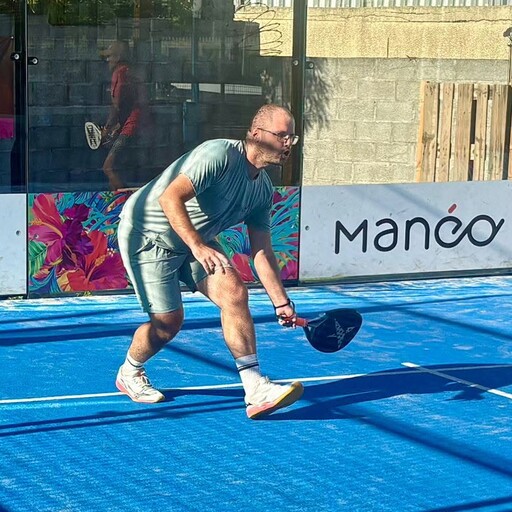
Padel produces a slightly different elbow strain profile than tennis. The shorter strokes with high grip pressure and frequent wall-rebound contacts load the medial side of the elbow (golfer’s elbow) more than the lateral side. If your pain is on the inner elbow rather than outer, the same kt tape tennis elbow application guide principles apply but mirrored: the 4-strip pattern flips to support the wrist flexor mass instead of extensors.
Padel players who develop both lateral and medial elbow pain (about 15% of cases according to Spanish padel clinic data) sometimes need a combined taping pattern. A skilled physiotherapist can teach a 6-strip variant that supports both sides without over-restricting the elbow joint. This is worth a single 45-minute consultation rather than trial-and-error self-taping.
How to learn the technique quickly
The fastest reliable path to a sound kt tape tennis elbow application guide skill:
- Watch 2-3 reputable physiotherapist YouTube tutorials specifically on lateral epicondylopathy taping (Bob and Brad, Tom Goom and similar)
- Practice on yourself 5 times before relying on the tape during a match
- Photograph each application from 3 angles, compare to clinical references
- Ask a club physiotherapist for a 15-min check the first time you apply before a tournament
Once learned, application drops to 5 minutes and the tape becomes a regular part of your match-day kit.
What the research actually shows vs marketing claims
The honest take, based on the studies cited above:
- Strong evidence: short-term (4-6 week) pain reduction during activity when combined with eccentric loading
- Moderate evidence: proprioceptive cueing improves perceived grip strength during functional tasks
- Weak evidence: standalone use without rehab produces meaningful tendon recovery
- No evidence: claims of “lymphatic drainage” or “toxin removal” found in some marketing
Treat KT tape as a useful adjunct, not a hero intervention. The serious work happens in the loading protocol, the technique audit, and the recovery gear stack.
Bottom line
KT tape is a useful 5-minute support layer for tennis elbow, not a treatment. Learn the 4-strip application, apply 30-60 min before play, replace every 3-5 days, and stack it with eccentric loading + red light therapy. Players who run a complete kt tape tennis elbow application guide alongside the actual rehab system get back on court with confidence and stay there.