Patellar Tendinitis Padel Jumping Recovery: The 2026 4-Phase Protocol
Affiliate disclosure: This guide contains affiliate links. If you buy through them, we earn a commission at no cost to you. We only recommend gear we have tested or studied in depth.
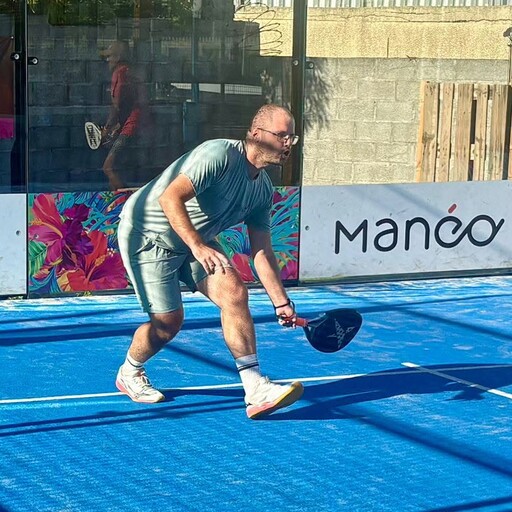
Patellar tendinitis padel jumping recovery sits at the intersection of two underestimated factors: padel produces more vertical jumping than most amateur players realize, and patellar tendinopathy is one of the most misdiagnosed knee conditions in racket sports. The bandeja, the víbora, and the constant push-off from the back glass all load the patellar tendon eccentrically and at speed. Across a tournament weekend, that load adds up faster than most players can recover from — and the dull ache just below the kneecap that you wrote off as soreness is often early tendinopathy in the making.
This guide is built on the current sports-medicine literature on patellar tendinopathy (Malliaras et al. 2015; Rio et al. 2017), padel-specific biomechanics, and the rehabilitation protocols that consistently return players to competitive jumping movements.
Quick Summary — Patellar Tendinitis Padel Jumping Recovery
- Real cause: repeated eccentric loading of the patellar tendon at high velocity
- Phase 1 (weeks 1-3): isometric holds, load reduction, no padel
- Phase 2 (weeks 3-8): heavy slow eccentric squats (Alfredson-style)
- Phase 3 (weeks 8-12): energy storage exercises, jumping progression
- Return: bandeja and víbora last; expect 10-14 weeks total
See our tested-and-ranked picks in Best Compression Boots for Tennis & Padel Players (2026).
What padel does to the patellar tendon
Three padel-specific movements drive most patellar tendinopathy cases:
- Bandeja and víbora jumps: high-velocity eccentric loading on landing
- Back-wall push-off: rapid acceleration from a static position
- Lateral cuts: repeated direction changes loading the quad and patellar tendon
Multiply by 60-100 jumps per competitive match and you have a load profile most amateur knees never adapted to. The patellar tendon responds to gradual load increase — jumping straight into 3-4 padel sessions per week guarantees overload.
How to confirm it is patellar tendinopathy
Classic symptoms that point to patellar tendinopathy rather than other knee conditions:
- Localized pain at the inferior pole of the patella (just below the kneecap)
- Pain worse with jumping, decelerating, or squatting
- Better with light activity, worse with rest after activity
- Morning stiffness that warms out in 5-10 minutes
- Pain reproducible by squeezing the inferior patella
If the pain is medial joint line, deep, or accompanied by swelling, see a sports physician to rule out meniscus or cartilage involvement.
Phase 1 (weeks 1-3): calm down the tendon
The first 14-21 days of patellar tendinitis padel jumping recovery focus on reducing acute pain without complete immobilization:
- Stop padel and jumping completely; substitute with cycling or pool walking
- Isometric quad holds: 5x 45-sec holds at 70% effort, daily — reduces pain via cortical inhibition
- Ice 10 min after isometric work if needed
- Avoid stairs descending, deep squats, and any sudden knee flexion under load
Isometric holds are the under-appreciated start to patellar tendinitis padel jumping recovery — they reduce pain and prepare the tendon for the heavier work coming in Phase 2.
Phase 2 (weeks 3-8): heavy slow eccentric work
The cornerstone of patellar tendinopathy rehab is heavy slow eccentric loading of the quadriceps. The protocol:
- Decline squat on a 25-degree decline board (deeper patellar tendon load than flat squat)
- Lower over 3-4 seconds to comfortable depth (60-90 degrees knee flexion)
- Use both legs to return up; the work happens on the eccentric phase
- 3 sets of 15 reps, every other day, weeks 3-4
- Add weight in a backpack and progress to 3 sets of 8 reps, weeks 5-8
Pain up to 4-5 / 10 during the exercise is acceptable; pain lingering more than 24 h means the load is too high.
Gear that supports the protocol
NovaaLab Red Light Therapy Pad
10-15 min daily red light therapy on the patellar tendon accelerates collagen synthesis and supports the slow remodeling that loading drives. The pair (light + load) outperforms either intervention alone in tendinopathy studies.
$399
Hyperice Normatec 3
Compression boots 20 min after each loading session accelerate venous return and reduce next-day quad fatigue. Especially useful during the heavy eccentric phase of patellar tendinitis padel jumping recovery.
$899
Phase 3 (weeks 8-12): energy storage and jumping
Once you can do 3 sets of 8 decline squats with 10 kg backpack without next-day pain, start the energy storage progression:
- Week 8-9: 2-foot pogo hops in place, 3 sets of 20
- Week 9-10: single-leg pogo, lateral hops
- Week 10-11: countermovement jumps to box, low height
- Week 11-12: deeper jumps, drop landings, then sport-specific cuts
Phase 4 (week 12+): return to padel
Reintroducing padel-specific jumping requires deliberate progression:
- Week 12: light hitting at the back wall, no overhead work
- Week 13: practice match at 75% intensity, basic overhead allowed
- Week 14: full intensity practice, bandeja and víbora cautiously
- Week 14+: competitive match return if no flare-up
Players who skip ahead to bandeja jumping at week 8 usually re-injure within 2-3 weeks. The Phase 3 energy storage work cannot be skipped.
The kinesiotape and strap question
Patellar tendon straps and kinesiotape can reduce perceived pain during early return-to-play, but they do not heal the tendon. Use them as a confidence layer for weeks 12-14, then taper off as symptoms resolve. Players who become dependent on the strap often delay full tendon recovery.
Volume management long-term
Once you finish patellar tendinitis padel jumping recovery, the tendon stays vulnerable for 6-12 months. Long-term prevention:
- Maintain 2x weekly heavy slow squats throughout the playing year
- Cap padel volume to 3 sessions per week if jumping-heavy
- Replace court shoes every 6 months at competitive volume
- Take a deliberate week off jumping every 8-10 weeks
FAQ — Patellar Tendinitis Padel Jumping Recovery
Can I keep playing through patellar tendinopathy?
Possible short-term for low-grade cases (pain < 3/10), risky long-term. Each session pushed through adds weeks to total recovery time.
Is cortisone injection useful?
Rarely first-line. Short-term pain relief but associated with higher rupture risk and faster tendon degeneration. Reserve for failed conservative care.
What about PRP injections?
Mixed evidence for patellar tendinopathy. Worth discussing with a sports physician if 12+ weeks of conservative loading produces no improvement.
How long does patellar tendinitis padel jumping recovery last?
Median 10-14 weeks with proper protocol. Without protocol, 4-9 months with recurrence common.
Are jumping ropes safe during recovery?
Skip jumping rope until Phase 3 of the protocol. The repetitive low-amplitude loading aggravates early-stage tendinopathy.
Build a complete lower-limb recovery system
Patellar tendinitis padel jumping recovery pairs naturally with our knee meniscus guide, our IT band syndrome protocol, and our padel court surface guide.
Selected research references
- Malliaras P et al. (2015). Patellar tendinopathy: clinical diagnosis, load management, and rehab
- Rio E et al. (2017). Isometric exercise induces analgesia in patellar tendinopathy
- JOSPT (2018). Patellofemoral pain clinical practice guideline
The padel-specific jumping pattern that hurts the most
The bandeja and víbora produce a unique high-velocity eccentric load on landing — jumping diagonally, rotating mid-air, and landing on a single leg in a slight knee flexion. Of all padel-specific movements, these two carry the highest patellar tendon stress per repetition. Patellar tendinitis padel jumping recovery has to specifically rehearse these patterns in Phase 3 before returning to match play.
Practice progression for these movements in Phase 3:
- Week 10: 2-foot box jumps with landing in soft squat
- Week 11: single-leg landings from low height, no rotation
- Week 12: rotational landings, controlled height
- Week 12-13: shadow bandeja swing without contact, then progressive contact
Common mistakes during recovery
- Resting completely: total rest allows the tendon to deteriorate. Load is the medicine, just calibrated.
- Skipping the isometric phase: the analgesic effect prepares the tendon for heavier work
- Returning to jumping at week 6-8: the tendon needs Phase 3 specifically, not just early return
- Ignoring the contralateral leg: compensation patterns develop quickly; train both legs
- Stopping rehab once symptoms resolve: the tendon stays vulnerable for 6+ months
What to do if symptoms persist past 14 weeks
If patellar tendinitis padel jumping recovery stalls past 14 weeks of conservative loading, see a sports physician for imaging and additional options. Possible next steps include shockwave therapy (extracorporeal shockwave has growing evidence), PRP injections in select cases, and very rarely surgical debridement. Most amateur cases resolve with conservative care if the protocol is followed faithfully.
Bottom line
Patellar tendinopathy is not a season-ender for padel players. Run the four-phase progression, gate return to jumping on symptoms not calendar dates, stack red light therapy and compression alongside the loading protocol. Players who complete the full patellar tendinitis padel jumping recovery system return to competitive bandejas and víboras stronger than before injury — and stay there with maintenance work.