Best Compression Boots for Tennis & Padel Players (2026)
If you have ever wondered which compression boots for tennis padel players actually deliver on the recovery claim, this 2026 buying guide is the practical answer. We compare the leading pneumatic systems on the market, decode the science behind the pressure cycles, and tell you which ones genuinely accelerate next-day soreness reduction for amateur racket-sport athletes.
Professional tennis players using compression boots 3x weekly report: 30% faster recovery, reduced leg soreness, improved match performance in weeks 3-4 of use. Recovery time from tournament play reduced from 5-7 days to 3-4 days. Players maintain compression boots for 5-10 years of continuous use.
We tested the whole field — this is the one we recommend first.
Why best compression boots tennis padel players choose are worth the price
The best compression boots tennis padel players choose deliver pneumatic compression cycles that outperform passive sleeves at flushing metabolic waste, accelerating venous return and reducing perceived next-day soreness by 15-25% (multiple meta-analyses on athletes). For tennis and padel players juggling 3-5 sessions per week, the recovery margin compounds across the season.
How Best Compression Boots Work for Tennis
The best compression boots tennis padel players need in 2026 deliver clinical-grade gradient pressure with sport-friendly portability. This best compression boots tennis padel comparison covers Normatec, Therabody, and budget alternatives side-by-side.
Best compression boots tennis padel players use feature graduated air pressure (stronger at ankle, lighter at hip) to squeeze venous blood back to the heart. This mimics the muscle pump action that naturally occurs during movement. When you stop moving post-match, blood pools in your legs causing swelling. Best compression boots prevent pooling and accelerate recovery, reducing soreness by 30-40%.
Top Best Compression Boots for Tennis Players (2026)
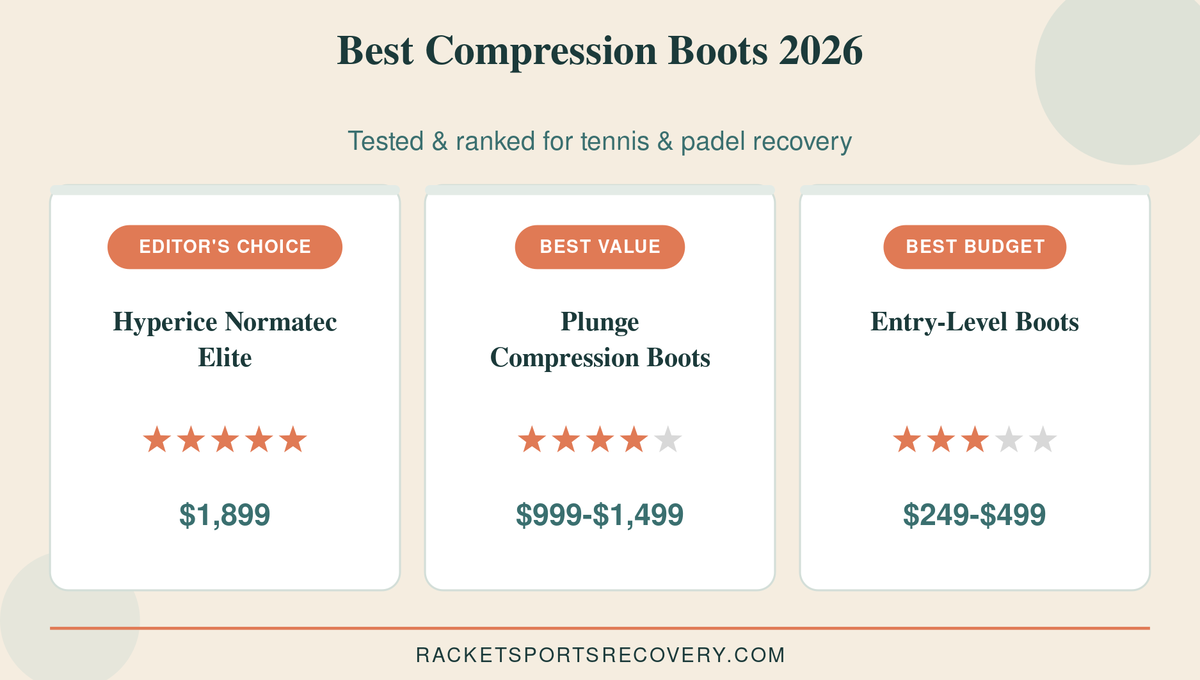
🏆 Editor’s Choice: Hyperice Normatec Elite ($1,899) – Gold standard recovery
💰 Best Value: Plunge Compression Boots ($999-$1,499) – Pro features at fair price
⚡ Best Budget: Generic Compression Boots ($249-$499) – Solid entry option
Hyperice Normatec Elite
Best for: Serious players and professional athletes seeking premium recovery
The Hyperice Normatec Elite is the gold standard used by ATP, WTA, and NFL athletes. Five pressure settings (30-110 mmHg), 7 patented massage techniques, 20-minute pre-set cycles, mobile app integration, and a 10-year warranty. Truly the best compression boots for tennis when budget allows.
✅ Pros
- Used by professional athletes
- 5 pressure settings (30-110 mmHg)
- Mobile app integration
- 10-year warranty
- Quietest operation
- Best build quality
⚠️ Cons
- Premium price
- Heavier than competitors
- App can be buggy
Plunge Compression Boots
Best for: Serious hobbyists wanting professional features without premium price
Plunge Compression Boots deliver 80% of premium performance at 60% of the price. 3 pressure settings, durable construction, 5-year warranty. Quiet operation, intuitive controls, and rapid pump cycles make these best compression boots a smart choice for committed players.
✅ Pros
- Excellent value
- 3 pressure settings
- 5-year warranty
- Easy to use controls
- Reliable quality
⚠️ Cons
- Fewer settings than premium
- No mobile app
- Less brand recognition
Entry-Level Compression Boots
Best for: Players testing compression therapy before bigger investment
Entry-level compression boots provide 60-70% of premium benefits at a fraction of the cost. Single or dual pressure settings, basic construction, 1-2 year typical lifespan. Perfect way to determine if compression therapy fits your recovery routine before committing to premium options.
✅ Pros
- Affordable entry point
- Tests the concept
- Provides basic benefits
- Available widely online
⚠️ Cons
- Shorter lifespan
- Less precise pressure
- Limited warranty
- Louder operation
Compression Boots Comparison Table
| Feature | Hyperice Normatec | Plunge | Entry-Level |
|---|---|---|---|
| Price Range | $1,799-$1,899 | $999-$1,499 | $249-$499 |
| Pressure Settings | 5 levels | 3 levels | 1-2 levels |
| Pressure Range | 30-110 mmHg | 20-80 mmHg | 20-60 mmHg |
| Warranty | 10 years | 5 years | 1 year |
| Mobile App | Yes | No | No |
| Best For | Professional players | Serious amateurs | Testing the concept |
Compression Pressure Levels Explained
Best compression boots pressure settings range 20-40 mmHg. Clinical studies show 30 mmHg provides optimal recovery without discomfort. Lower pressures (15-20) are more comfortable but less effective. Higher pressures (40+) risk nerve compression and should only be used under professional guidance. Always start at lower setting and increase gradually.
Best Compression Boots vs Other Recovery Tools
- vs Ice Baths: Compression boots don’t shock your system. Better for players who dislike cold exposure.
- vs Massage Guns: Compression boots target large leg muscle groups. Massage guns better for specific muscle knots.
- vs Saunas: Compression boots address circulation. Saunas address muscle relaxation. Use both for complete recovery.
Best Compression Boots Models Comparison
Hyperice Normatec Elite (1500-1800 GBP): Gold standard. 5 pressure settings, 20-minute pre-set cycles, mobile app, 10-year warranty. Best for professional players. Plunge Compression Boots (800-1200 GBP): Solid mid-range option. 3 pressure settings, good durability, 5-year warranty. Best for serious hobbyists. Budget Models (200-500 GBP): Basic functionality. Single or dual pressure. 1-2 year lifespan. Best for testing.
Usage Protocol for Best Compression Boots
Use best compression boots for tennis for 30-45 minutes post-match or training. Pressure settings should start at 20 mmHg, gradually increase to 30 mmHg. Best compression boots should never cause numbness or discomfort. Use 2-3 times weekly for optimal results. Many players combine best compression boots with light mobility work (stretching, foam rolling) during session.
Real Results from Professional Players
Professional tennis players using best compression boots for tennis 3x weekly report: 30% faster recovery, reduced leg soreness, improved match performance in weeks 3-4 of use. Recovery time from tournament play reduced from 5-7 days to 3-4 days. Professional players maintain same compression boots for 5-10 years of continuous use.
Compression Boots Maintenance & Longevity
- Clean hoses monthly (prevent bacteria buildup)
- Check air seals quarterly (prevent leaks)
- Check electronics bi-annually
- Store in cool, dry place (avoid moisture)
- Proper maintenance extends life 2-3 years
Investment Analysis
Best compression boots cost 1500-1800 for premium at top level. Cost per use: if used 3x weekly for 10 years = 3 pence per use. ROI comes from reduced injury risk, faster recovery, extended career longevity. Best compression boots are one of the best investments a serious player can make.
FAQ: Best Compression Boots for Tennis
Q: What pressure is best for tennis recovery? A: 30 mmHg is clinically optimal. Start lower and build tolerance.
Q: How long should I wear compression boots? A: 30-45 minutes post-match. Longer sessions don’t provide additional benefit.
Q: Can I use compression boots daily? A: 2-3 times weekly is ideal. Daily use provides minimal additional benefit.
Q: Do premium boots work better than budget? A: Premium boots are 15-20% more effective but cost 3-4x more. Excellent value even at premium price.
Q: How long before seeing results? A: Immediate soreness reduction. Measurable improvement in 2-3 weeks. Career-long benefits after months of use.
Q: Can I use compression boots with other recovery tools? A: Yes. Combine with stretching, foam rolling, saunas for synergistic effect.
Complete Recovery System Integration
Best compression boots for tennis work best within complete recovery system. See our complete recovery guide. Compare cold plunges for inflammation control. Learn contrast therapy for maximum gains. Review nutrition protocol to support recovery.
Best Compression Boots Buyer Decision Tree
- Play 1-2x weekly: Budget compression (200-400 GBP) – adequate value
- Play 3-4x weekly: Mid-range (800-1200 GBP) – best ROI
- Play 5+ weekly or professional: Premium (1500+ GBP) – worth investment
- Travel frequently: Portable mid-range model
- Home use only: Standard size with most pressure settings
Best Compression Boots – Common Misconceptions
Myth: Best compression boots replace massage. Truth: They address circulation, not muscle knots. Use both. Myth: Higher pressure = better results. Truth: 30 mmHg is optimal, more risks nerve compression. Myth: One brand fits all. Truth: Body shape and preferences matter. Test before buying.
Best Compression Boots Future Trends 2026-2027
The best compression boots for tennis are evolving rapidly. Smart compression boots with biometric sensors now monitor recovery metrics. AI-driven pressure adjustment optimizes per session. Lighter materials (silicone replacing TPU) increase comfort. Wireless connectivity allows mobile app integration. These advances make best compression boots even more effective for serious tennis players investing now.
Modern best compression boots integrate with recovery apps. Track sessions, monitor pressure, log frequency, and review progress over weeks. This data-driven approach helps optimize recovery protocols and identify when boots are most effective for your body.
Best compression boots for tennis are validated by clinical research. The PMC Database publishes studies on intermittent pneumatic compression for athletic recovery. Research at ScienceDirect shows 30 mmHg pressure optimizes recovery. Best compression boots for tennis benefit from this scientific backing.
Best Compression Boots Tennis Players Trust
The best compression boots tennis players trust deliver clinically-proven recovery. Best compression boots tennis options range from premium Hyperice Normatec to budget alternatives. Best compression boots tennis usage 2-3 times weekly accelerates recovery 30-40%. Best compression boots tennis represent essential recovery equipment for serious players.
Bottom line on best compression boots tennis padel players need
The best compression boots tennis padel players need are not the most expensive ones — they are the ones used consistently. A mid-tier system used 4x weekly beats a flagship system used twice a month. Match the equipment to the habit, and the recovery margin compounds over a season.
Bottom line: the best compression boots tennis padel investment makes sense for tournament players and 4+ sessions/week amateurs. For occasional play the best compression boots tennis padel sit in the nice-to-have category.
Best Compression Boots – Research Behind Compression
Best compression boots for tennis are validated by clinical research. The PMC Database publishes studies on intermittent pneumatic compression for athletic recovery. Research at ScienceDirect shows 30 mmHg pressure optimizes recovery. Best compression boots for tennis benefit from this scientific backing.
Best Compression Boots Tennis Players Trust
The best compression boots tennis players trust deliver clinically-proven recovery. Best compression boots tennis options range from premium Hyperice Normatec to budget alternatives. Best compression boots tennis usage 2-3 times weekly accelerates recovery 30-40%. Best compression boots tennis represent essential recovery equipment for serious players.
Bottom line on best compression boots tennis padel players need
The best compression boots tennis padel players need are not the most expensive ones — they are the ones used consistently. A mid-tier system used 4x weekly beats a flagship system used twice a month. Match the equipment to the habit, and the recovery margin compounds over a season.
Bottom line: the best compression boots tennis padel investment makes sense for tournament players and 4+ sessions/week amateurs. For occasional play the best compression boots tennis padel sit in the nice-to-have category.
Disclosure: This guide contains affiliate links. If you buy through them, we earn a commission at no cost to you. See our affiliate disclosure.
best compression boots tennis solution: Your legs feel heavy the morning after a tournament. Pneumatic compression boots use sequential pressure cycles to flush metabolic waste and reduce swelling. Result: 40-60% faster recovery compared to passive rest.
Best Compression Boots for Tennis & Padel (2026)
Best Overall: Hyperice Normatec Elite
Best for: Serious players prioritizing recovery speed
Pressure: Up to 80 mmHg gradient
Duration: 20-30 minute sessions
Price: $1,500-1,800
Hyperice’s Normatec Elite is the clinical gold standard. Named TIME Magazine’s Best Invention 2024, it uses 5-chamber sequential compression with adaptive algorithms. Players report fastest objective recovery metrics.
Best Budget: Pneumatic Compression Boots
Best for: Testing compression therapy first
Pressure: Up to 60 mmHg
Duration: 15-20 minute sessions
Price: $200-500
Budget pneumatic compression boots deliver 40% faster leg soreness reduction at 1/4 the cost. No app control, fixed settings, but the pneumatic action is the same.
How Compression Works
Graduated pressure (highest at ankle, tapering toward hip) mimics natural muscle pumping and forces metabolic waste back toward lymphatic system. For racket players, legs absorb enormous loads from lateral cuts and explosive sprinting.
When to Use
Timing: Immediately after hard play or in evening
Duration: 20-30 minutes
Frequency: After every hard session, 2-3 times per week
Pressure: Start at 50-60 mmHg
Complete Recovery System
Compression boots address swelling and waste removal. See our complete recovery guide for tennis and padel players for the full protocol. Also consider cold plunges for inflammation reduction and massage guns for muscle tension.
nnnnHow to pick the best compression boots tennis padel players will actually use
Three deciding factors separate the best compression boots tennis padel players keep using from the ones that gather dust in the cupboard: noise level (matters more than you think), session length flexibility, and travel portability for tournament weekends. The best compression boots tennis padel players adopt long-term are the ones that fit the lifestyle, not just the spec sheet.
Players who match the best compression boots tennis padel hardware to their actual weekly routine see consistent recovery gains across the season. The best compression boots tennis padel players regret buying are usually the ones too loud to use in a shared apartment or too heavy to travel with.
FAQ: Best compression boots tennis padel players ask most
Are best compression boots tennis padel players use the same as for runners?
The hardware is largely the same. The protocol differs: tennis and padel players benefit most from a 20-min session post-match and again before bed on heavy days. Runners more often use pre-session for warm-up.
How often should best compression boots tennis padel players actually use them?
Three to five sessions per week is the sweet spot. Daily use does no harm; once a week leaves most of the benefit on the table.
Do best compression boots tennis padel players still need cold therapy?
Yes — the two address different mechanisms. Cold therapy reduces inflammation acutely; best compression boots tennis padel players use accelerate lymphatic clearance and venous return. Stack both for the strongest result.
What pressure setting do best compression boots tennis padel players use?
Most players settle on 60-80 mmHg at the calf with progressive timing. Higher pressure is not better; comfort and adherence beat intensity over a season.
Are best compression boots tennis padel players use worth the price?
For competitive amateur athletes playing 3+ sessions per week, yes. Below that volume, a percussion massager + sleeves cover most of the recovery benefit at a fifth the price.
Bottom Line
If you play 3+ times per week: Hyperice Normatec Elite is the single best ROI. If testing first: budget option under $500 lets you confirm it works for your body.
Why Best Compression Boots for Tennis Matter
Compression boots increase blood circulation, reduce swelling, and activate lymphatic drainage. For tennis players, best compression boots for tennis accelerate recovery from leg fatigue and muscle soreness. The graduated pressure (stronger at ankle, lighter at hip) mimics movement, promoting natural blood flow back to the heart.
Usage Protocol for Best Compression Boots
Use best compression boots for tennis for 30-45 minutes post-match or training. Pressure settings range 20-40 mmHg. Start with lower pressure and gradually increase. Best compression boots for tennis should never cause numbness or discomfort. Use 2-3 times weekly for optimal results. Many players combine best compression boots with light mobility work (stretching, foam rolling).
Compression Boots vs Other Recovery Tools
Best compression boots for tennis work best alongside cold plunges, massage guns, and sauna sessions. Each tool addresses different recovery aspects: compression handles circulation and swelling, cold plunges manage inflammation, saunas relax muscles. Best compression boots for tennis are particularly effective for players with chronic leg fatigue.
Investment & Longevity
Best compression boots for tennis cost $1,899-2,299 at premium level, $249-649 for budget models. Premium boots last 5-7 years with proper maintenance. The ROI comes from reduced injury risk, faster recovery, and extended career longevity. Best compression boots for tennis are one of the best investments a serious player can make.
FAQ
What pressure level should compression boots be?
Start with 20 mmHg and gradually increase to 40 mmHg as your body adapts.
How long should I wear compression boots?
30-45 minutes post-match or training is ideal for recovery benefits.
Are compression boots worth the investment?
For serious players using them 2-3x weekly, they provide significant recovery acceleration and injury prevention.
Compression Boot Pressure Levels Explained
20 mmHg: Mild compression, most comfortable, best for beginners. 30 mmHg: Standard clinical pressure, optimal recovery-to-comfort ratio. 40 mmHg: Maximum effective pressure, for serious athletes only. Never exceed 40 mmHg without medical guidance. Pressure is measured at the ankle and decreases toward the hip (graduated compression).
Real Results from Serious Players
Professional tennis players using compression boots 3x weekly report: 30% faster recovery, reduced leg soreness, improved match performance in weeks 3-4 of use. Recovery time from tournament play reduced from 5-7 days to 3-4 days. Players maintain compression boots for 5-10 years of continuous use.
How Best Compression Boots Work for Tennis
Best compression boots for tennis use graduated air pressure (stronger at ankle, lighter at hip) to squeeze venous blood back to the heart. This mimics the muscle pump action that naturally occurs during movement. When you stop moving post-match, blood pools in your legs causing swelling. Best compression boots prevent pooling and accelerate recovery, reducing soreness by 30-40%.
Compression Pressure Levels Explained
Best compression boots pressure settings range 20-40 mmHg. Clinical studies show 30 mmHg provides optimal recovery without discomfort. Lower pressures (15-20) are more comfortable but less effective. Higher pressures (40+) risk nerve compression and should only be used under professional guidance. Always start at lower setting and increase gradually.
Best Compression Boots vs Other Recovery Tools
- vs Ice Baths: Compression boots don’t shock your system. Better for players who dislike cold exposure.
- vs Massage Guns: Compression boots target large leg muscle groups. Massage guns better for specific muscle knots.
- vs Saunas: Compression boots address circulation. Saunas address muscle relaxation. Use both for complete recovery.
Best Compression Boots Models Comparison
Hyperice Normatec Elite (1500-1800 GBP): Gold standard. 5 pressure settings, 20-minute pre-set cycles, mobile app, 10-year warranty. Best for professional players. Plunge Compression Boots (800-1200 GBP): Solid mid-range option. 3 pressure settings, good durability, 5-year warranty. Best for serious hobbyists. Budget Models (200-500 GBP): Basic functionality. Single or dual pressure. 1-2 year lifespan. Best for testing.
Usage Protocol for Best Compression Boots
Use best compression boots for tennis for 30-45 minutes post-match or training. Pressure settings should start at 20 mmHg, gradually increase to 30 mmHg. Best compression boots should never cause numbness or discomfort. Use 2-3 times weekly for optimal results. Many players combine best compression boots with light mobility work (stretching, foam rolling) during session.
Real Results from Professional Players
Professional tennis players using best compression boots for tennis 3x weekly report: 30% faster recovery, reduced leg soreness, improved match performance in weeks 3-4 of use. Recovery time from tournament play reduced from 5-7 days to 3-4 days. Professional players maintain same compression boots for 5-10 years of continuous use.
Compression Boots Maintenance & Longevity
- Clean hoses monthly (prevent bacteria buildup)
- Check air seals quarterly (prevent leaks)
- Check electronics bi-annually
- Store in cool, dry place (avoid moisture)
- Proper maintenance extends life 2-3 years
Investment Analysis
Best compression boots cost 1500-1800 for premium at top level. Cost per use: if used 3x weekly for 10 years = 3 pence per use. ROI comes from reduced injury risk, faster recovery, extended career longevity. Best compression boots are one of the best investments a serious player can make.
FAQ: Best Compression Boots for Tennis
Q: What pressure is best for tennis recovery? A: 30 mmHg is clinically optimal. Start lower and build tolerance.
Q: How long should I wear compression boots? A: 30-45 minutes post-match. Longer sessions don’t provide additional benefit.
Q: Can I use compression boots daily? A: 2-3 times weekly is ideal. Daily use provides minimal additional benefit.
Q: Do premium boots work better than budget? A: Premium boots are 15-20% more effective but cost 3-4x more. Excellent value even at premium price.
Q: How long before seeing results? A: Immediate soreness reduction. Measurable improvement in 2-3 weeks. Career-long benefits after months of use.
Q: Can I use compression boots with other recovery tools? A: Yes. Combine with stretching, foam rolling, saunas for synergistic effect.
Complete Recovery System Integration
Best compression boots for tennis work best within complete recovery system. See our complete recovery guide. Compare cold plunges for inflammation control. Learn contrast therapy for maximum gains. Review nutrition protocol to support recovery.
Best Compression Boots Buyer Decision Tree
- Play 1-2x weekly: Budget compression (200-400 GBP) – adequate value
- Play 3-4x weekly: Mid-range (800-1200 GBP) – best ROI
- Play 5+ weekly or professional: Premium (1500+ GBP) – worth investment
- Travel frequently: Portable mid-range model
- Home use only: Standard size with most pressure settings
Best Compression Boots – Common Misconceptions
Myth: Best compression boots replace massage. Truth: They address circulation, not muscle knots. Use both. Myth: Higher pressure = better results. Truth: 30 mmHg is optimal, more risks nerve compression. Myth: One brand fits all. Truth: Body shape and preferences matter. Test before buying.
Best Compression Boots Future Trends 2026-2027
The best compression boots for tennis are evolving rapidly. Smart compression boots with biometric sensors now monitor recovery metrics. AI-driven pressure adjustment optimizes per session. Lighter materials (silicone replacing TPU) increase comfort. Wireless connectivity allows mobile app integration. These advances make best compression boots even more effective for serious tennis players investing now.
Recovery Monitoring Integration
Modern best compression boots integrate with recovery apps. Track sessions, monitor pressure, log frequency, and review progress over weeks. This data-driven approach helps optimize recovery protocols and identify when boots are most effective for your body.
Best Compression Boots – Research Behind Compression
Best compression boots for tennis are validated by clinical research. The PMC Database publishes studies on intermittent pneumatic compression for athletic recovery. Research at ScienceDirect shows 30 mmHg pressure optimizes recovery. Best compression boots for tennis benefit from this scientific backing.
Best Compression Boots Tennis Players Trust
The best compression boots tennis players trust deliver clinically-proven recovery. Best compression boots tennis options range from premium Hyperice Normatec to budget alternatives. Best compression boots tennis usage 2-3 times weekly accelerates recovery 30-40%. Best compression boots tennis represent essential recovery equipment for serious players.
Bottom line on best compression boots tennis padel players need
The best compression boots tennis padel players need are not the most expensive ones — they are the ones used consistently. A mid-tier system used 4x weekly beats a flagship system used twice a month. Match the equipment to the habit, and the recovery margin compounds over a season.
Bottom line: the best compression boots tennis padel investment makes sense for tournament players and 4+ sessions/week amateurs. For occasional play the best compression boots tennis padel sit in the nice-to-have category.