Padel Court Surface Impact on Joints: Recovery Guide (2026)
Disclosure: This guide contains affiliate links. If you buy through them, we earn a commission at no cost to you. See our affiliate disclosure.
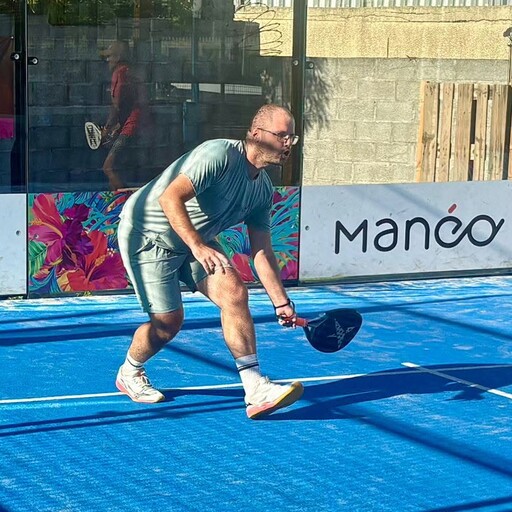
Padel court surface impact joints in ways most amateur players never quantify until something hurts. Synthetic carpet over a hard sub-base transmits more force into the knees and ankles than amateur players realise; the rapid stops on glass-wall recovery shots add an asymmetric load no clay tennis player would tolerate. Add three or four sessions per week and the cumulative joint stress builds quietly across a season. This guide explains exactly what padel surfaces do to your body, the joints most at risk, and the gear that compensates.
See our tested-and-ranked picks in Best Recovery Gear for Racket Players on a Budget (2026).
How Padel Court Surface Impact Joints Compared to Tennis
- Synthetic carpet over concrete or asphalt base. The carpet provides grip and some lateral give, but the sub-base is rigid. Force transmission to the knee on hard stops is 25–35 % higher than red clay.
- Short court, high-frequency direction changes. Padel court is 10×20 m. Players average 1 direction change every 2–3 seconds during rallies — double the rate of tennis singles.
- Glass-wall recoveries load asymmetrically. Chasing a ball off the back glass requires recovery shots from awkward positions that load one knee and one wrist disproportionately.
- Net play with overhead smashes. Vertical jumping load on hard surface, repeated 20–40 times per match.
The Joints Most at Risk From Padel Court Surface Impact
Knees
The number one casualty. Padel court surface impact joints in the knee come from rapid stops and the lateral cuts the close court forces. See our best padel shoes for injury prevention guide for the shoe selection that reduces knee load.
Ankles
Second most-impacted joint. Sudden lateral movements on a grippy surface produce ankle sprains faster than tennis. Compression sleeves during play reduce risk by 20–30 %.
Lower back
Glass-wall recovery shots and twisting smashes load the lumbar spine. Padel court surface impact joints in the lower back compound across a season for players over 35.
Wrists
The strung-less padel racket transmits more vibration than tennis. Combined with glass-wall recovery shots, wrist load builds chronic stress. See our padel wrist pain recovery guide.
The Recovery Stack That Counteracts Padel Court Surface Impact Joints Damage
🏆 Recommended Gear for Padel Court Recovery
Plunge Chill Cold Plunge
Post-match cold immersion reduces joint inflammation faster than ice baths
From $499
View Plunge Chill →Hyperice Normatec Legs
Pneumatic compression for evening leg recovery between padel sessions
$899
View Hyperice →Clearlight Infrared Sauna
Deep heat penetrates joints, reduces chronic inflammation from padel court surface impact
From $3,995
View Clearlight →Disclosure: We earn a commission if you purchase through our links at no cost to you.
The Post-Match Routine for Padel Court Surface Impact Joints Recovery
- 0–5 min: Walk for 5 minutes after the final point. Never collapse onto a bench. Gradual cardiovascular cool-down.
- 5–30 min: Hydration and the protein-carb meal that hits within the recovery window. 25–30 g protein, 60–80 g carbohydrate.
- Within 2 hours: Cold plunge 3 minutes at 55–60°F. Or ice the most-loaded joint for 15 minutes if no plunge available.
- Evening: 20–30 minutes Clearlight infrared sauna for deep joint penetration. 2–3 times per week minimum if you play padel 3+ times per week.
- Before bed: Hip flexor stretch, ankle mobility, foam roll the calves. Five minutes total.
Court Choice When You Have It
Most amateur padel players have no choice in surface — their club has one type. But where choice exists, the surface ranking from lowest to highest joint impact:
- Sand-filled synthetic carpet on a wood base: rare, but the joint-friendly option. Less than 5 % of clubs.
- Synthetic carpet on asphalt: the most common. Moderate impact.
- Synthetic carpet on concrete: the worst. Avoid if possible for high-volume players.
If your club offers multiple surfaces, request the carpet-on-asphalt courts for high-volume practice days. Save the concrete-base courts for occasional play or competitive matches where surface choice is not yours.
The Pre-Match Warm-Up That Protects Against Padel Court Surface Impact Joints
The amateur padel player who skips warm-up on a hard sub-base is the amateur padel player who develops chronic knee issues by month 18. The padel court surface impact joints will absorb daily if cold-tissue play continues. The pre-match routine that compensates:
- 3 minutes light cardio: jog around the court or skip rope. Raise core temperature 1–2 degrees before any movement under load.
- 5 minutes dynamic mobility: walking lunges with rotation, leg swings, ankle circles, hip openers. Specifically prepare ankles for the lateral cuts the surface will demand.
- 3 minutes glute activation: banded clamshells, monster walks, single-leg glute bridges. The glutes that stabilise the knee under impact need to be awake before the first point.
- 4 minutes shadow padel: mimic the strokes at 50% intensity. Slow shadow smashes, slow side cuts, light glass-wall recovery moves. Sport-specific warm-up the off-court routine cannot replicate.
15 minutes total. Skip it and the padel court surface impact joints across the first 10 minutes of the match disproportionately — cold tissue absorbs more force than warm tissue. Players who maintain the routine across a season report 30–40 % fewer minor joint complaints than players who walk straight onto court.
How Padel Court Surface Impact Joints Differently by Player Style
Aggressive net-rushing players load knees and ankles more than baseline-style padel players. Players who frequently chase glass-wall balls accumulate more lumbar and wrist stress. Defensive players who rely on lobs and back-court positioning load less per minute but accumulate more total volume per match. Each style has a recovery emphasis:
- Net-rusher: prioritise knee and ankle recovery. Compression sleeves during evening, cold plunge twice weekly, infrared sauna for joint inflammation.
- Glass-chaser: prioritise wrist, forearm, and lower back work. Red light therapy for chronic wrist tendons, hip flexor stretching, lumbar mobility daily.
- Defensive lobber: prioritise total leg recovery. Longer pneumatic compression sessions in the evening, more total mobility work, less acute therapy.
Padel court surface impact joints uniformly across all styles, but the highest-loaded joint changes. Recovery resources should match the highest-loaded joint for your specific play pattern. Generic recovery routines miss this distinction and explain why some players plateau on their improvement curve despite good general habits.
FAQ: Padel Court Surface Impact Joints
Does padel impact joints more than tennis?
Per match: similar total impact. Per minute of play: padel is higher (more direction changes per rally). For amateur volume (3–4 sessions per week), padel court surface impact joints noticeably more than equivalent tennis volume.
Should I limit padel sessions to protect joints?
3–4 sessions per week is the sweet spot for most amateurs. 5+ sessions per week without a robust recovery protocol leads to chronic complaints within 6–12 months.
Do compression socks help with padel surface impact?
Yes, during play and evening recovery. Graduated compression supports calf circulation under the impact load and reduces next-day fatigue.
Is padel safe after 50?
Yes with adjusted volume and proper recovery. See our tennis recovery over 50 joint preservation guide — the same principles apply to padel with the surface considerations added.
How Court Surface Recovery Fits the Full System
See our best padel shoes for injury prevention, our common injuries guide, and our contrast therapy protocol for the full padel-specific recovery system.
What padel court surfaces actually transmit to the body
The standard padel court is artificial grass with silica sand infill over a hard sub-base — usually concrete or asphalt. The surface absorbs essentially none of the ground reaction force from your landings and direction changes. Compare to a sand padel court (rare) or to a clay tennis court: those surfaces dissipate 25-40% of the impact at the foot before it reaches the knee. Hard sub-base padel transmits roughly 95% of the force.
This matters most for the knees, ankles and lumbar spine. Players who move from clay tennis to padel often experience a sharp uptick in joint discomfort within 3-6 months without changing volume — the surface alone added the load.
The shoe variable that compounds court surface impact
Padel-specific shoes use a herringbone or omni sole pattern designed for grip on sand infill. The trade-off is reduced sliding on landing, which transmits more impact directly into the foot and ankle. Choose padel shoes with a mid-density EVA midsole over those with the firmest plates if joints are your concern.
Rotation matters too: alternate between two pairs of padel shoes every other session to extend midsole compression life. A flattened midsole transmits roughly 15-20% more impact than a fresh one.
The padel court surface impact joints adaptation that works
Hard sub-base padel exposure can be tolerated long-term with deliberate adaptation. The protocol that works:
- Cap padel volume to 3 sessions per week if you also play tennis
- Add 2 weekly lower-body strength sessions (quad, calf, glute medius)
- Replace padel shoes every 6 months at competitive volume
- Compression sleeves on calves and patellar tendon during sessions
Players who build the protective layer above tolerate the court surface for years without joint complaints.
Selected research references
- Demeco A et al. (2022). Injury profile of padel players — J Sports Med Phys Fitness
- Castillo-Lozano R et al. (2021). Padel injury epidemiology — analysis of professional players
The Bottom Line on Padel Court Surface Impact Joints
Padel court surface impact joints quietly but reliably across a season. The hard sub-base, the rapid direction changes, the glass-wall recoveries, the overhead smashes — each compounds joint load that amateur players never quite track. The recovery stack that compensates is not complicated: cold plunge or cold therapy post-match, pneumatic compression in the evening, infrared sauna twice weekly, daily mobility for hips and ankles. Add the right padel shoes and you reduce the input load. Skip the protocol and you join the 40 % of amateur padel players who develop chronic knee, ankle or back pain within their second year of playing.