Knee Meniscus Tennis Return to Play: The 2026 Phase-by-Phase Protocol
Affiliate disclosure: This guide contains affiliate links. If you buy through them, we earn a commission at no cost to you. We only recommend gear we have tested or studied in depth.
A meniscus injury is the diagnosis that quietly retires more amateur tennis and padel players over 35 than any other knee problem. The good news the MRI report rarely tells you: most meniscus tears in racket sports can recover well enough for full match play if you run the right protocol. The bad news: knee meniscus tennis return to play is one of the most rushed decisions in amateur sport — players push back too early, re-injure the same tissue, and end up in a worse place than if they had waited 4 more weeks.
This guide is built from current ESSKA and JOSPT meniscus rehabilitation guidelines, the BOOST trial on meniscectomy vs. rehabilitation outcomes, and 20+ years of playing and research racket-sport athletes through the exact stop-or-go decision. We will cover the tear types that actually matter for racket sports, the conservative-vs-surgical decision, the 4-phase progression, and the criteria that predict a safe return.
Quick Summary — Knee Meniscus Tennis Return to Play
- Conservative path: 12-16 weeks for stable degenerative tears
- Post-surgical (partial meniscectomy): 6-10 weeks
- Post-surgical (repair): 4-6 months
- Key gate: single-leg squat to 60° pain-free, ≥ 90% strength symmetry
- Padel: add 1-2 weeks to any tennis timeline
See our tested-and-ranked picks in Best Compression Boots for Tennis & Padel Players (2026).
What actually tore (and why it matters)
The meniscus is a C-shaped cartilage disk that distributes load across the knee. There are two: medial (inside) and lateral (outside). Tear classification matters more than tear size for any knee meniscus tennis return to play decision:
- Degenerative tear: common after age 35-40, often without a specific injury event. Responds well to conservative rehab.
- Acute traumatic tear: usually from a twisting injury on a planted foot. May respond to conservative care if stable; otherwise surgical.
- Bucket-handle tear: a displaced fragment that mechanically locks the knee. Surgical — almost always.
- Root tear: tear at the meniscus attachment point. Often missed on initial MRI, biomechanically severe, usually needs surgical repair.
If your sports physician or orthopedic surgeon has not told you which tear type you have, ask. The knee meniscus tennis return to play timeline diverges by months across these categories.
Conservative vs. surgical: the BOOST trial finding
For degenerative meniscus tears, the BOOST trial (and a Cochrane review building on it) showed that exercise-based rehab matches partial meniscectomy outcomes at 12 months on pain and function. Translation: for the 35+ amateur racket player with a degenerative tear, 12 weeks of structured rehab is usually a better first option than surgery. Save the operating room for failed conservative care or for tear patterns that genuinely require it.
For acute traumatic tears in younger players, the calculus shifts. Repair has better long-term joint preservation than meniscectomy, but the rehab is twice as long. Discuss with a knee surgeon who follows current evidence, not the surgical default of 10-15 years ago.
Phase 1 (weeks 0-3): control swelling, protect the joint
Whether you choose conservative or surgical, Phase 1 looks similar:
- Crutches as needed for the first 5-7 days, weight-bear as tolerated
- Compression sleeve 24/7 to control effusion
- Ice 15 min 3-4x daily
- Pain-free range-of-motion: heel slides, quad sets, gentle stationary bike
- Quad activation: terminal knee extensions, glute bridges
The goal of this phase is a quiet knee — less than half a finger-width of swelling, full passive extension, 0-120° flexion. Players who skip this phase carry chronic effusion into later phases and stall progress.
Phase 2 (weeks 3-6): strength foundation
This is the phase that decides knee meniscus tennis return to play timelines. The goal: rebuild quadriceps, hamstring, and glute strength symmetry within 15% of the healthy side.
Three sessions per week:
- Goblet squats to comfortable depth, 3 sets of 10, progress weight gradually
- Step-ups, 3 sets of 10 per leg, progress to single-leg control
- Hamstring bridges, 3 sets of 12
- Single-leg balance, 30 sec, eyes open then closed
- Stationary bike, 20-30 min, low resistance
Phase 3 (weeks 5-9): impact and direction change
Once strength symmetry is in range, add controlled impact:
- Week 5-6: 2-foot pogo hops, treadmill jog 15 min, lateral shuffles
- Week 6-7: single-leg hops in place, controlled lateral hops, light shadow swings
- Week 7-8: court warm-up at 50% pace, mini-tennis service line to service line
- Week 8-9: baseline rallying at 70% pace, no point play
Gear that supports the protocol
Hyperice Normatec 3 (Legs)
Pneumatic compression boots 20 min daily reduce knee effusion, accelerate quad recovery between rehab sessions, and shave time off Phase 1-2 swelling control.
$899
Plunge Chill Cold Plunge
Cold-water immersion at 10-12°C for 10 min after each rehab session controls swelling and acute pain. Use from week 2 onward (avoid in immediate post-op week).
$2,990+
Phase 4 (weeks 9-14): match return
This is where knee meniscus tennis return to play sits on a knife edge. Two athletes with identical tears might return at week 9 and week 14 depending on how cleanly they clear the criteria gate:
- Single-leg squat to 60° pain-free
- Single-leg hop distance ≥ 90% of healthy side
- Triple hop test ≥ 90% of healthy side
- No effusion 24h after a full practice session
- Quad strength symmetry ≥ 90%
Match return progression:
- Week 9-10: first practice match at 70% intensity, monitor swelling next morning
- Week 10-12: 75-85% practice match intensity, 2x weekly
- Week 12+: competitive match entry if no flare-up
The padel adjustment
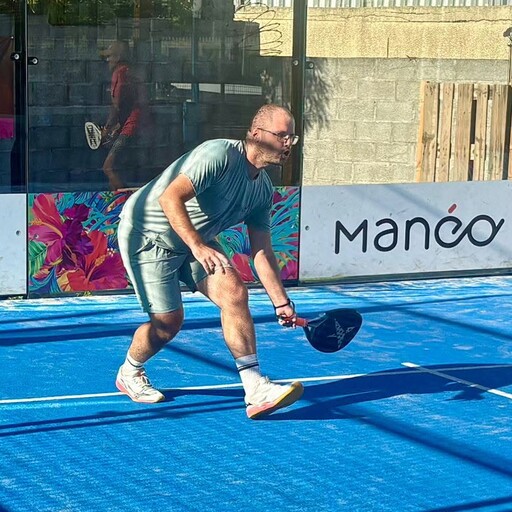
Padel is harder than singles tennis on the meniscus. The constant lateral push-offs off the back wall, the planted-foot pivots near the side glass, and the jump-landing for bandejas all load the meniscus more than baseline tennis. Add 1-2 weeks to every phase in any knee meniscus tennis return to play timeline if padel is your primary sport. Players who skip this adjustment are over-represented in the re-injury statistics.
What about a knee brace?
An off-the-shelf neoprene sleeve provides modest proprioceptive benefit and warmth, both useful for the first 3-6 months back. Functional hinged braces help only if there is associated ligament instability. Most racket-sport meniscus players benefit from a quality sleeve through month 6, then drop it if no recurrence.
FAQ — Knee Meniscus Tennis Return to Play
I had an arthroscopy. When can I rally?
After a partial meniscectomy, light rally at week 4-5 is usually safe if swelling is controlled. After a meniscus repair, no rally before week 12-14. The repair protects the tissue; the meniscectomy removes torn tissue.
Can I play with a tear if I have no pain?
Sometimes, yes. Asymptomatic degenerative tears are common after age 40 and not all need treatment. Discuss with a knee specialist before assuming silence means safe.
Why does my knee swell only after I play, not during?
Delayed effusion at 6-24 hours post-match is the classic meniscus pattern. It means you exceeded what the joint can tolerate. Back off intensity by 20% and re-test the next session.
Will I get arthritis from this?
A meniscus injury raises long-term arthritis risk, especially after a meniscectomy. The single best protection is maintaining quad strength and a healthy body weight for life. Strength training is joint preservation.
Should I get a second opinion before surgery?
Almost always for a meniscectomy on a degenerative tear in an amateur player. The current evidence has shifted toward conservative-first; second opinions from a sports-medicine physician often confirm that path.
Build a complete knee-and-leg recovery system
Knee meniscus tennis return to play pairs naturally with our IT band syndrome guide, our compression boots roundup, and our tennis recovery over 50 guide.
The Thessaly test and what the clinical exam still misses
Most amateur racket players arrive at a knee meniscus tennis return to play conversation only after an MRI. Worth knowing: the clinical exam still matters because MRI over-detects in the 40+ population. The Thessaly test (standing on the injured leg with the knee at 20° flexion, rotating the body internally and externally three times) reproduces the meniscal symptom in about 75% of true mechanical tears. If your MRI shows a tear but the Thessaly is negative and you have no mechanical symptoms (locking, clicking, catching), the tear may be incidental and conservative care is even more strongly indicated.
Always pair imaging with a hands-on exam by a sports physician before committing to a knee meniscus tennis return to play surgical timeline.
Strength work that protects the meniscus long-term
Once you finish rehab, the meniscus stays vulnerable for life. The single most protective intervention is sustained quad-and-glute strength training. Two key sessions per week:
- Squat variation (goblet, front, or split) — 3 sets of 6-10
- Single-leg work (Bulgarian split squat, step-up) — 3 sets of 8 per side
- Hamstring work (Romanian deadlift, Nordic curl progression) — 3 sets of 6-8
- Calf strength (heel raises with load) — 3 sets of 12
Players who keep this routine post-rehab almost never return to the clinic for the same knee.
Selected research references
- Sihvonen R et al. (2013). Arthroscopic partial meniscectomy vs sham — NEJM
- Beaufils P et al. (2022). ESSKA meniscus consensus
- AAOS OrthoInfo — Meniscus tears patient guide
Bottom line
A meniscus tear is not a season-ender for most amateur racket players. Diagnose the tear type honestly, run the 4-phase progression, gate match return on functional criteria not calendar dates, and add a padel buffer if relevant. Players who follow the full knee meniscus tennis return to play protocol come back at the same level — sometimes better — and stay healthier long term.